
Why Product Consistency Matters in the Global Frozen Food Industry

Written By
Admin
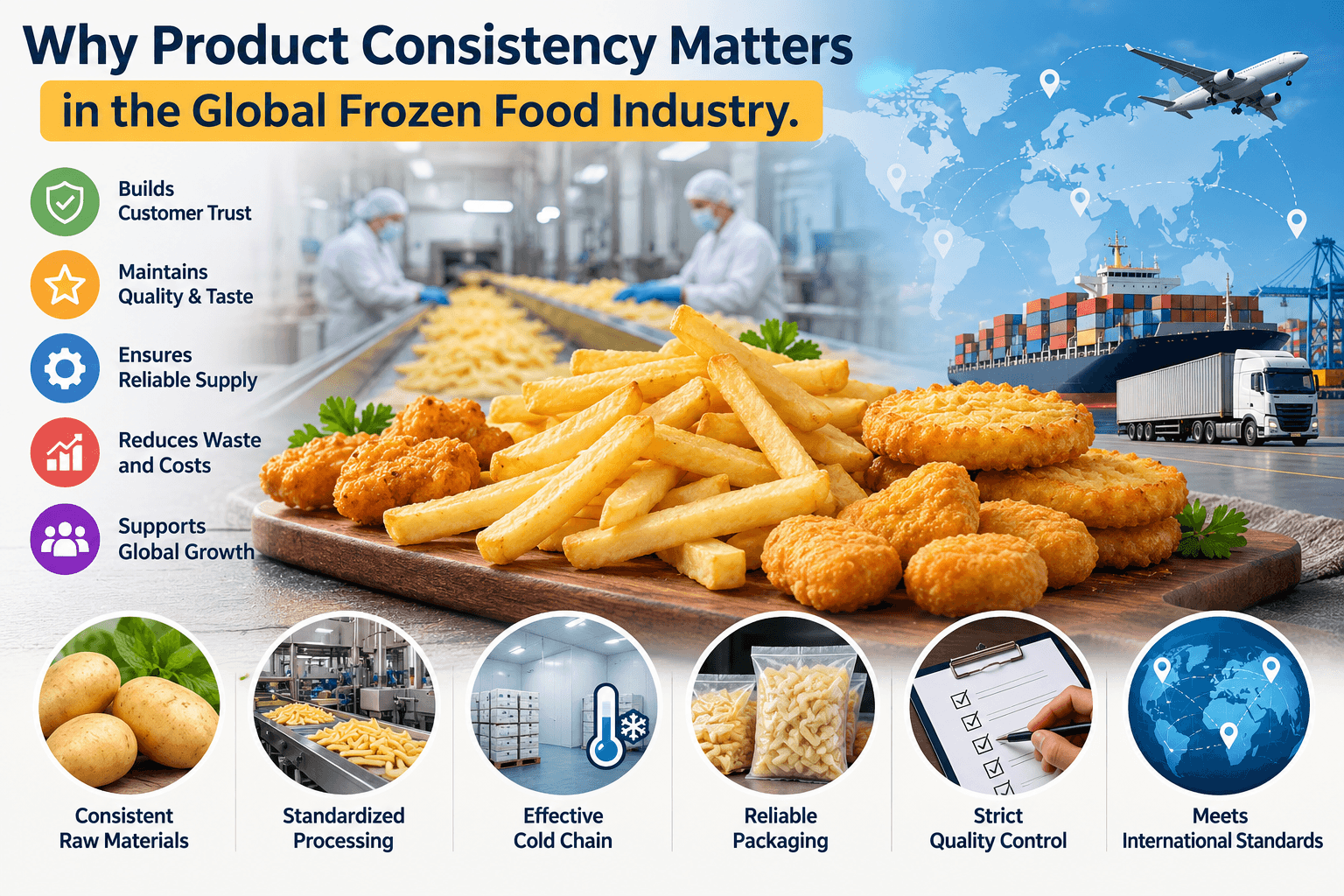
The global frozen food industry continues to grow as consumers, restaurants, retailers, and food-service businesses seek convenient, reliable, and high-quality food products. From frozen French fries and potato nuggets to hash browns and other frozen snacks, customers expect consistent taste, texture, appearance, and cooking performance with every purchase.
For manufacturers and suppliers, product consistency is essential for building customer trust, maintaining brand reputation, and developing long-term business relationships. In the competitive international marketplace, businesses involved in frozen food export must maintain reliable production standards and effective quality-control practices to meet buyer expectations across different markets.
1. Building Customer Trust and Brand Loyalty
Product consistency plays an important role in building customer confidence. When buyers receive products that meet their expectations with every order, they are more likely to trust the supplier and continue purchasing from the same business.
For restaurants and quick-service restaurant (QSR) chains, consistent taste, size, crispiness, and appearance are particularly important. Customers expect their favourite food products to deliver a similar experience every time. Variations in quality can affect customer satisfaction and damage a restaurant's reputation.
By maintaining consistent product standards, frozen food manufacturers can strengthen relationships with distributors, importers, retailers, and food-service businesses while encouraging repeat orders.
2. Maintaining Taste, Texture, and Appearance
Taste, texture, and appearance are essential characteristics of frozen food products. Customers expect French fries to cook evenly, potato nuggets to maintain their shape, and hash browns to deliver a consistent texture.
Achieving these results requires careful raw material selection, standardized processing methods, appropriate freezing techniques, and suitable packaging. Differences in potato quality, moisture content, product dimensions, or processing conditions can affect the final product.
Manufacturers should establish clear product specifications and conduct regular quality checks to minimize variations between production batches. Consistency in these characteristics helps businesses meet buyer expectations and maintain product reliability across different applications.
3. Strengthening Quality Control
Effective quality control is fundamental to consistent frozen food production. Manufacturers need systematic procedures to inspect raw materials, monitor processing conditions, evaluate finished products, and maintain accurate production records.
Standard operating procedures help employees follow established processes, while regular inspections can identify potential problems before products reach customers. Businesses should also investigate recurring quality issues and implement corrective measures.
For companies involved in frozen food export, documented quality-control practices can support product traceability and help meet applicable customer requirements and destination-market regulations. A structured approach to quality management also improves accountability and supports continuous improvement.
4. Maintaining the Cold Chain
Cold-chain management is essential for protecting frozen food quality during storage and transportation. After processing and freezing, products must be stored, handled, and transported under appropriate temperature conditions.
Temperature fluctuations, damaged packaging, and improper handling can negatively affect product texture and overall quality. Manufacturers and logistics partners should use suitable cold-storage facilities, temperature monitoring, and appropriate transportation systems.
Maintaining the cold chain helps products reach distributors, retailers, restaurants, and other customers in the expected condition. It is particularly important when shipments travel long distances or pass through multiple distribution points before reaching their destination.
5. Meeting International Buyer Expectations
International buyers evaluate frozen food suppliers based on product quality, specifications, packaging, documentation, and supply reliability. Consistency across production batches and shipments is especially important for importers and distributors serving established markets.
Businesses involved in frozen food export should clearly define product dimensions, ingredients, packaging formats, storage requirements, and shelf life where applicable. Accurate documentation and effective communication help buyers manage procurement and distribution more efficiently.
Manufacturers must also understand the regulations and product requirements applicable to their destination markets. Meeting agreed specifications and communicating any product changes in advance can help reduce misunderstandings and support stronger international business relationships.
6. Reducing Waste and Operational Costs
Product inconsistency can create unnecessary costs for manufacturers, distributors, and food-service businesses. Products that fail to meet agreed specifications may require additional inspections, replacement, rework, or disposal.
Restaurants can also experience inconsistent cooking results, affecting preparation time, portion control, and food waste. These challenges may reduce operational efficiency and affect customer satisfaction.
By monitoring production performance, identifying the causes of quality problems, and improving manufacturing procedures, businesses can reduce avoidable losses. Consistent products help companies plan operations more effectively, manage costs, and provide more dependable service to customers.
7. Using Standardized Processes and Technology
Modern food-processing technology can help manufacturers maintain consistent product dimensions, processing conditions, freezing performance, and packaging quality. Automation can reduce certain variations between production batches when equipment is properly configured and maintained.
However, technology alone cannot guarantee consistency. Employee training, equipment maintenance, standardized operating procedures, and regular quality reviews are equally important.
Traceability systems can also help manufacturers track raw materials, production batches, packaging records, and distribution information. These records make it easier to investigate quality issues and identify opportunities for improvement.
Combining appropriate technology with trained employees and effective quality-management practices creates a stronger foundation for reliable frozen food production.
8. Supporting Long-Term Growth in International Markets
The international frozen food market offers opportunities for manufacturers that can supply dependable products and meet the requirements of different customer segments. However, expanding into new markets requires more than competitive pricing or a broad product range.
Exporters need to demonstrate their ability to maintain agreed product specifications, coordinate logistics, manage supply requirements, and communicate effectively with buyers. Consistency helps establish confidence during initial orders and becomes even more important as commercial relationships develop.
For importers, distributors, retailers, and restaurant chains, working with a reliable supplier can simplify purchasing decisions and support predictable operations. Manufacturers that prioritize product consistency can build a stronger reputation, encourage repeat orders, and establish a sustainable position in the global frozen food industry.
Conclusion
Product consistency is a key factor in the global frozen food industry because it supports customer satisfaction, brand reputation, operational efficiency, and reliable supply chains. Maintaining consistent taste, texture, appearance, and product specifications helps manufacturers reduce waste and meet buyer expectations. Effective quality control, standardized production procedures, appropriate technology, and proper cold-chain management are essential for delivering dependable products. These practices are particularly important for businesses involved in frozen food export, where maintaining agreed standards across international shipments helps strengthen customer confidence and long-term business relationships.
ChillFill Foods is an Indian frozen potato-snacks manufacturer and exporter offering products such as frozen French fries, hash browns, potato nuggets, potato patties, and other frozen snacks. The company serves business customers, including distributors, importers, restaurants, and food-service businesses. For businesses exploring frozen food export opportunities from India, ChillFill Foods provides a product range to consider for their sourcing requirements. Visit ChillFill Foods to explore its products and enquire about available varieties, packaging options, and potential supply partnerships.