
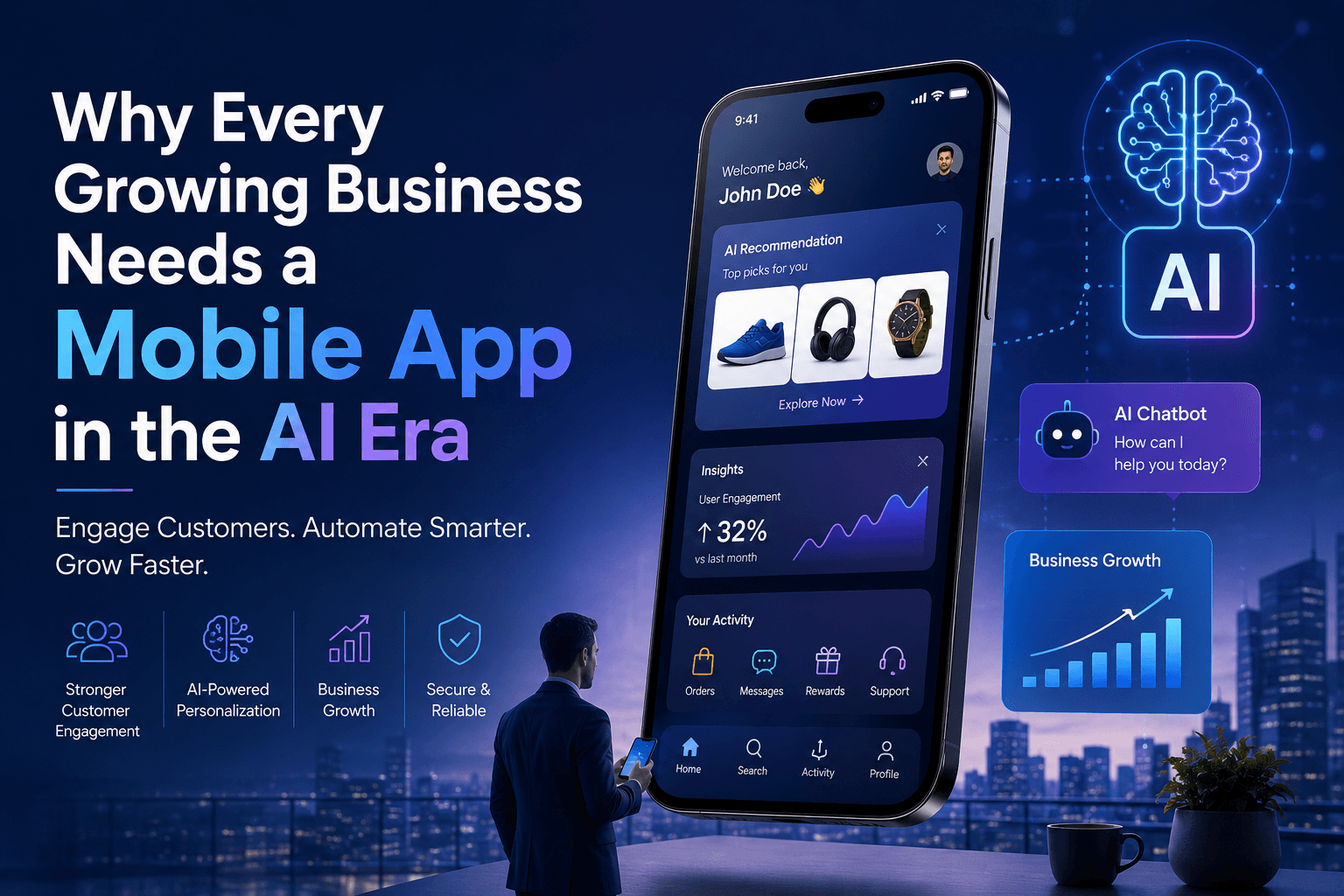
Why Every Growing Business Needs a Mobile App in the AI Era

Written By
Admin
Key Takeaways
- Businesses without a dedicated mobile presence are losing ground to competitors who are already delivering AI-powered, personalized app experiences to their customers every single day.
- Mobile app development services have evolved far beyond simple interfaces; they now serve as the primary channel for customer engagement, real-time data collection, and AI-driven personalization.
- Custom mobile apps give growing businesses direct access to customer behavior data that third-party platforms like social media and marketplaces never share back with you.
- AI integration inside mobile applications is no longer a feature reserved for large enterprises; affordable frameworks and cloud-based AI APIs have made intelligent app experiences accessible to businesses at every stage of growth.
- App-based engagement consistently outperforms web-based engagement on retention, session time, and conversion rate, making a mobile application one of the highest-ROI investments a growing business can make.
- Enterprise app development principles, including scalable architecture, offline capability, and deep system integrations, are now the standard expectation even for mid-market and SMB applications.
- The businesses building mobile apps today in the AI era are creating a compounding data and personalization advantage that will be structurally difficult for late movers to close.
The Window Is Open, But It Will Not Stay That Way
Somewhere right now, a customer who would have bought from you just opened a competitor's app, found exactly what they needed in three taps, and placed an order without ever visiting a website.
That is not a hypothetical. It is the commercial reality of 2025 and 2026 for businesses across retail, healthcare, services, logistics, and B2B. The shift to mobile-first consumer behaviour happened years ago. The shift to AI-powered mobile experiences is happening now, and it is happening fast enough that the gap between businesses with capable mobile applications and those without is widening every quarter.
This guide is written for founders, growth leaders, and operations teams at growing businesses who are weighing whether the investment in mobile application development is justified. The answer is yes, but the more important question is why, and what kind of app actually moves the needle. Both questions get a thorough answer here.
The Real Cost of Not Having a Mobile App
Before making the case for mobile app development services, it is worth being honest about what businesses without apps are actually losing. This is not a theoretical opportunity cost. It is measurable revenue and retention leakage happening in real time.
Customer Engagement Is Migrating to App-First Experiences
Consumer behavior data from 2024 and 2025 consistently shows that mobile apps deliver significantly higher engagement than mobile websites across nearly every industry vertical. App users open a product on average 11 times per month compared to 4 times for mobile web visitors. Push notifications achieve open rates of 7 to 10%, while email open rates in most industries have fallen below 25% and continue declining.
The mechanism behind this engagement gap is straightforward. An app lives on a user's device. It is one tap from the home screen. It can notify, personalize, and remember preferences in ways that a browser session fundamentally cannot replicate. For businesses where repeat engagement drives lifetime value, whether that is a restaurant chain, a fitness brand, a B2B SaaS product, or a healthcare provider, this engagement gap translates directly to revenue.
You Do Not Own Your Customer Relationship on Third-Party Platforms
Businesses that rely on social media platforms, marketplaces, or aggregators for customer engagement are building on rented land. Algorithm changes, platform policy updates, and fee increases are outside your control. When Instagram reduced organic reach for business accounts, brands that had invested in their own apps retained direct communication channels that platform-dependent brands lost overnight.
A custom mobile app means you own the notification channel, the user data, the purchase history, and the behavioral patterns. That ownership is a business asset with compounding value. It is also what enables the AI-powered personalization features that are now driving measurable revenue lifts for businesses that have built their apps on the right foundations.
What the AI Era Actually Changes for Mobile Apps
![Diagram showing how AI capabilities integrate into mobile app layers including personalization engine, voice interface, predictive analytics, and on-device ML]
The intersection of AI era business growth and mobile application development is where the most significant commercial opportunity currently exists. Understanding exactly how AI changes the value of a mobile app helps prioritize what to build and what to invest in.
Personalization at a Scale That Was Previously Impossible
Traditional mobile apps could segment users into broad categories and show different content to different groups. AI-powered mobile apps can now personalize at the individual level, in real time, based on behavioral signals that accumulate with every session.
Starbucks is the most cited enterprise example of this working at scale. Its mobile app uses machine learning models trained on order history, location data, time of day, and weather patterns to predict what individual customers are likely to order before they open the app. The result is higher average order values and a meaningful reduction in checkout friction.
For a growing business, the same capability is now accessible through cloud-based AI services from AWS, Google Cloud, and Azure that can be integrated into a custom mobile app without requiring an in-house machine learning team. The infrastructure cost has dropped dramatically. The competitive advantage it creates has not.
On-Device AI for Speed, Privacy, and Offline Capability
One of the most significant developments in mobile AI over the past two years is the maturation of on-device inference through frameworks like Apple's CoreML and Google's ML Kit. These tools allow AI models to run directly on the user's device without sending data to a server.
For growing businesses, this has practical implications beyond the technical:
- Healthcare and legal apps can offer AI-powered features without transmitting sensitive user data off the device, reducing compliance risk.
- Retail apps can offer real-time visual search and product recognition even in low-connectivity environments.
- Logistics and field-service apps can run route optimization and anomaly detection offline, critical for teams working in areas with unreliable mobile data.
On-device AI is not a marginal feature. It is the architecture decision that determines whether your app works reliably for users in real-world conditions, not just in a demo environment with full connectivity.
Predictive and Proactive Experiences Replace Reactive Interfaces
The traditional mobile app is reactive. The user opens it, makes a request, and receives a response. AI-era mobile apps are increasingly proactive. They anticipate the next need before the user articulates it.
A field service management app that uses predictive analytics to alert a technician that a part on a client's equipment is likely to fail in the next 30 days, before the client calls with a breakdown, is not science fiction. It is a competitive differentiator that companies like ServiceMax and FieldAware are already delivering through enterprise app development for their customers.
For a growing business building its first or second-generation mobile application, embedding predictive capabilities from the start, through AI APIs that connect behavioral data to outcome models, is dramatically less expensive than retrofitting them later onto an app that was not designed for it.
Why App-Based Engagement Outperforms Every Other Digital Channel
The data on app-based engagement versus web and social engagement is no longer ambiguous. Apps win on nearly every metric that matters for business outcomes, and the gap is widening as AI personalization capabilities improve.
Conversion Rates
Retail apps convert at rates 3 to 5 times higher than mobile web across most product categories. The reasons are structural, not incidental. Saved payment methods, pre-filled addresses, biometric authentication, and persistent shopping carts reduce checkout friction in ways that a browser session cannot fully replicate. For a business doing $2 million in annual eCommerce revenue, closing even half the conversion gap between web and app typically justifies the development investment within the first 12 to 18 months.
Retention and Lifetime Value
App users have higher retention rates than web users across subscription services, content platforms, and service-based businesses. The combination of push notifications, personalized re-engagement sequences, and frictionless re-entry means that an app user who goes quiet for 14 days can be brought back with a targeted notification in a way that a lapsed web visitor cannot.
Duolingo's growth story is built almost entirely on app-based retention mechanics. Its streak system, push notification strategy, and gamified daily engagement loop have driven the company to over 500 million registered users with retention metrics that are structurally impossible to replicate in a browser experience.
Direct Revenue From In-App Capabilities
For B2B companies, custom mobile apps create revenue channels that did not previously exist. Field sales teams with mobile quoting tools close deals faster and with fewer errors. Service businesses with app-based scheduling reduce no-shows and administrative overhead. Subscription businesses with mobile billing and account management reduce churn by making it easy for customers to manage their relationships with you rather than simply cancelling when an issue arises.
Mobile App Development Services: What Growing Businesses Actually Need
Not all mobile app development services are created equal, and growing businesses with finite budgets need to understand the trade-offs before committing to an approach. The decision is not just technical; it is strategic.
Native vs Cross-Platform: Making the Right Choice
Native development for iOS (Swift) and Android (Kotlin) delivers the highest performance and deepest access to device capabilities. It is the right choice for apps where the user experience is a primary differentiator, where you need deep integration with device hardware, or where you are building for a consumer audience that will compare your app against category leaders.
Cross-platform development using Flutter or React Native delivers a single codebase that deploys to both iOS and Android. It reduces development cost by 25 to 40% and cuts time to market significantly. For growing businesses building internal tools, B2B applications, or MVPs that need to validate product-market fit before investing in full native development, cross-platform is frequently the better strategic choice.
The mistake growing businesses make is treating this as a permanent decision. Start with cross-platform if speed and budget are the constraints. Build in architectural patterns that allow a future migration to native components for the highest-value features once you have data on how users actually engage with your app.
What Enterprise App Development Principles Mean for Smaller Teams
Enterprise app development is not just for large corporations. The principles it embodies, including scalable backend architecture, role-based access control, audit logging, offline-first design, and third-party system integration, are the exact same principles that prevent a growing business from having to rebuild its app from scratch 18 months after launch.
The most common and expensive mistake in mobile application development for growing businesses is under-investing in the backend architecture. A well-designed mobile app is two components of roughly equal importance: the client-side experience the user sees, and the backend infrastructure that determines what the app can actually do at scale.
A growing business that builds a beautiful front-end on a poorly designed backend will face a difficult and expensive rebuild exactly when it can least afford one: at the moment the business is growing fastest and placing the highest demands on the system.
AI Integration: Where to Start for Maximum Impact
For growing businesses investing in mobile app development services for the first time or upgrading an existing application, here are the AI integration priorities with the most immediate business impact:
Personalization and recommendation engines: Connect user behavioral data to a recommendation model that surfaces relevant content, products, or services based on individual patterns. AWS Personalize, Google Recommendations AI, and similar cloud services offer this capability through APIs that a competent development team can integrate in a sprint or two.
Intelligent search within the app: Replace keyword-based in-app search with semantic search that understands intent. A user searching for "something to help with headaches" in a pharmacy app should surface pain relief products, not return no results because the exact keyword was not matched. This is now a standard integration capability using embeddings and vector search.
Conversational AI for support and guidance: LLM-powered chat assistants embedded in a mobile app can handle a significant volume of support queries, onboarding guidance, and product questions without human intervention. The cost of handling a query through an AI assistant is a fraction of the cost of a human support interaction, and the response time is immediate.
Predictive analytics for operations: For businesses with field operations, inventory, or appointment-based services, AI-powered predictive models can reduce operational waste and improve resource allocation in ways that a standard reporting dashboard cannot.
Industry-Specific Value of Custom Mobile Apps in the AI Era
Retail and eCommerce
Retail apps with AI personalization are compressing the time between customer intent and purchase completion in ways that are fundamentally changing conversion economics. Brands like Nike, Zara, and Sephora have built mobile apps that function as personalized storefronts, loyalty platforms, and community hubs simultaneously. For growing retailers, a custom mobile app with basic AI personalization can differentiate against marketplace dependency and reduce the cost of customer acquisition by building a direct, repeat-purchase relationship.
Healthcare and Wellness
The healthcare app market has seen extraordinary growth driven by the convergence of mobile access, wearable device integration, and AI-powered health insights. Apps that connect to Apple Health or Google Fit and use ML models to surface personalized health recommendations are moving from premium features to user expectations. For growing healthcare and wellness businesses, mobile app development services that embed HIPAA-compliant data handling from the start are a legal requirement and a trust signal simultaneously.
Professional Services and B2B
The B2B mobile app opportunity is frequently underestimated. Enterprise clients increasingly expect their service providers to offer mobile tools for project tracking, document access, communication, and reporting. A professional services firm that offers a client portal as a mobile app is not just adding convenience; it is creating a switching cost by embedding itself into the client's workflow at a level that a web portal or email thread cannot match.
Salesforce's mobile app strategy demonstrates this at enterprise scale. The ability for a field sales team to access CRM data, log activities, and receive AI-generated next-best-action recommendations from a mobile device is one of the platform's strongest retention mechanisms.
Logistics and Field Operations
Offline-first architecture, GPS integration, barcode and QR scanning, and real-time route optimization are table stakes for logistics mobile apps in 2025 and 2026. Companies like Delhivery and FedEx have built competitive infrastructure partly through superior mobile tools for their field teams. For growing logistics operators, the operational efficiency gains from a well-built mobile app, fewer errors, faster delivery confirmation, better route adherence, can produce ROI that dwarfs the development cost within a single year.
How to Evaluate Mobile App Development Services for Your Business
The decision of which development partner to work with is as important as the decision to build the app. The evaluation criteria below are drawn from patterns observed across successful and unsuccessful mobile app engagements across industries.
Technical Architecture Review
Before any design conversation begins, ask prospective development partners how they approach backend architecture for scale. Specifically:
- How does the app handle 10x the current expected user load?
- What is the data model for storing and accessing user behavioral data?
- How are third-party API integrations structured to prevent single points of failure?
- What is the offline data synchronization strategy?
A development team that cannot answer these questions clearly in a discovery conversation is likely to produce an app that performs well in a demo and struggles in production.
AI Capability and Integration Experience
For a mobile application built in the AI era, ask specifically about the team's experience integrating AI and machine learning capabilities. Relevant questions include:
- Which AI APIs and frameworks has the team integrated in previous projects?
- How do they approach on-device versus cloud-based inference decisions?
- Can they show examples of apps they have built with recommendation engines or predictive features?
- How do they handle the data pipeline from user behavior collection through to model training and inference?
Post-Launch Support and Iteration Model
An app that launches and then receives no attention will degrade in quality rapidly as iOS and Android release new OS versions, third-party APIs deprecate endpoints, and user expectations evolve. Understand clearly what the development partner's post-launch model looks like before signing a contract.
FAQs
1. Why does a growing business need a mobile app in the AI era specifically?
The AI era changes the calculus for mobile apps in two specific ways. First, AI capabilities that were previously expensive and technically complex to build are now accessible through cloud APIs that can be integrated into a custom app at a fraction of the historical cost. Second, the data a mobile app collects, including behavioral patterns, session depth, and feature engagement, becomes the training material for the AI models that drive personalization and prediction. Businesses that start collecting this data now through their own mobile application will have a structural advantage over competitors who start later, because the value of AI models compounds with the volume and quality of training data.
2. How much does mobile app development cost for a growing business?
Development cost varies significantly based on complexity, platform choice, and the development partner. A focused MVP with a single core workflow, user authentication, backend API, and basic personalization typically costs between $25,000 and $80,000 depending on location and team composition. A full-featured app with custom AI integrations, multi-platform support, complex third-party integrations, and a robust backend typically ranges from $100,000 to $400,000. Cross-platform development (Flutter or React Native) reduces costs by 25 to 40% compared to building separate native iOS and Android applications. The more important number is the cost per unit of business value delivered, and well-structured mobile applications typically show positive ROI within 12 to 24 months.
3. What is the difference between a mobile app and a mobile website for customer engagement?
A mobile website is accessed through a browser and requires an internet connection for every interaction. It cannot send push notifications, access the device's biometric authentication without additional setup, store complex offline data, or integrate as deeply with device hardware. A mobile app is installed on the device, enabling offline functionality, native push notifications, biometric login, and persistent user sessions. App-based engagement data consistently shows higher session frequency, longer average session duration, and higher conversion rates compared to mobile web across most business categories. For businesses where customer engagement drives lifetime value, the app delivers meaningfully better outcomes.
4. How long does it take to build a mobile app for a growing business?
A focused MVP targeting a single platform (iOS or Android) or using a cross-platform framework like Flutter, with a clearly defined feature scope, typically takes 10 to 16 weeks from design to app store submission. A more complex application with multiple user roles, AI integrations, custom backend, and both iOS and Android deployment typically takes 20 to 32 weeks. Timeline is heavily influenced by how clearly the requirements are defined at the start of the engagement, how quickly design feedback is provided, and how responsive the business is during the review cycles.
5. What AI features make the most sense for a growing business's first mobile app?
The AI features with the highest ROI for a first mobile application are in-app personalization (surfacing relevant products, content, or services based on individual user behavior), intelligent search (semantic search that understands intent rather than matching keywords), and push notification optimization (AI-driven send-time optimization and content personalization for re-engagement sequences). These three capabilities can be integrated into a mobile application at relatively low cost using existing cloud AI services and deliver measurable improvements in conversion, retention, and engagement metrics from the first months of deployment.
Conclusion
The decision to invest in mobile app development services is no longer a question of whether your business is big enough. It is a question of whether you can afford to keep watching customer relationships flow through channels you do not own, while competitors build compounding advantages through apps that get smarter with every user interaction.
The AI era has done something important for growing businesses: it has brought the capabilities that previously required enterprise-scale resources within reach of any company willing to invest in building the right foundation. A well-built mobile application with thoughtful AI integration is now one of the highest-leverage growth investments a business can make.
The businesses that build now will spend the next three to five years widening the gap between themselves and those who delayed. The architecture you choose today, the data you start collecting tomorrow, and the AI models you train over the next 12 months will compound in ways that cannot be replicated by a competitor who decides to start building 18 months from now.