Advantages and Disadvantages of Vertical Injection Molding Machines

Written By
Admin
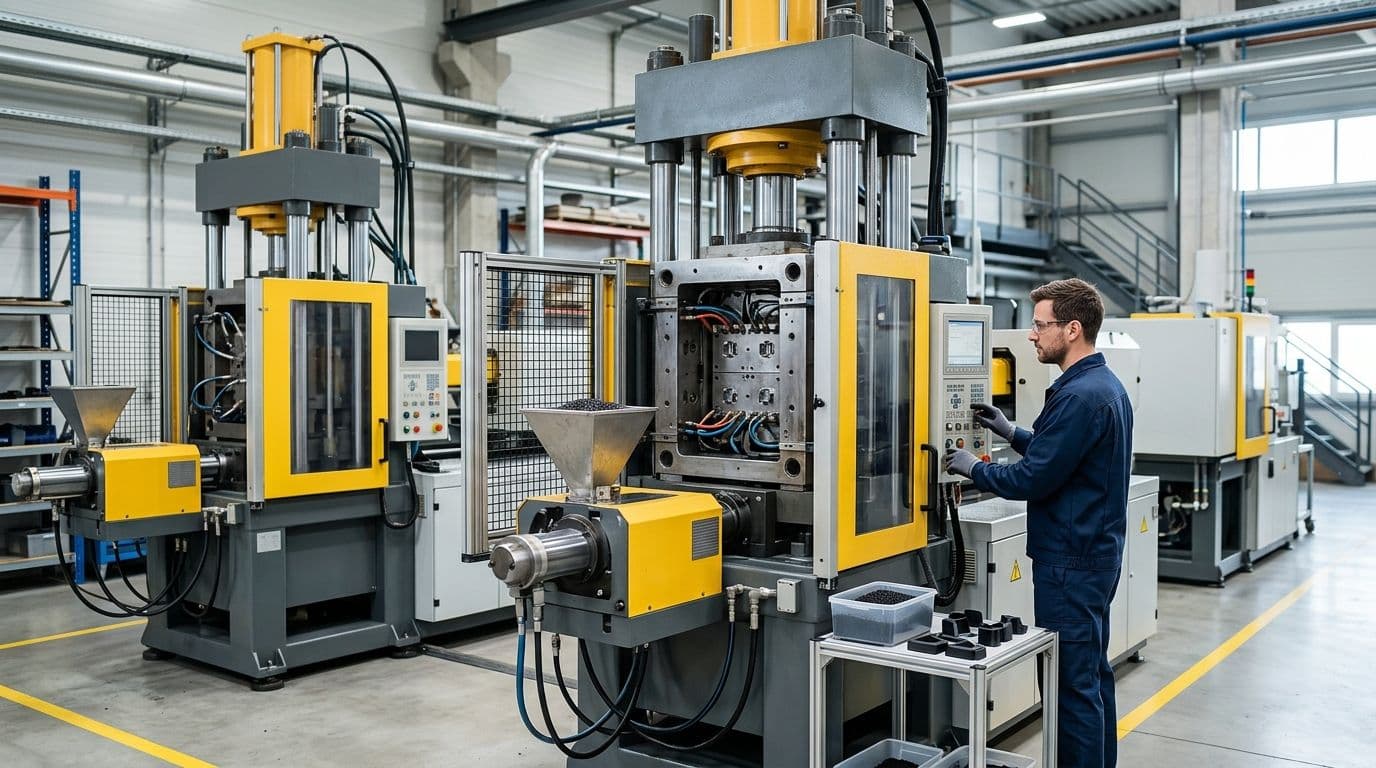
Vertical injection molding machines have become an important part of modern manufacturing. From electronics and medical devices to automotive connectors and cable assemblies, these machines are trusted across many industries for their precision and efficiency.
But like any equipment, vertical injection molding machines come with their own strengths and limitations. Before investing in one, it is important to understand both sides clearly. This guide from Paheej Machinery Pvt Ltd walks you through the key advantages and disadvantages of vertical injection molding machines so you can make the right decision for your production needs.
What Is a Vertical Injection Molding Machine?
A vertical injection molding machine injects molten plastic into a mould using a vertical clamping and injection axis. The mould opens upward and downward, and the injection unit sits on top. This design makes vertical machines especially well-suited for insert molding and overmolding applications.
The key components include the injection unit, clamping unit, rotary or sliding table, and the drive system — all working together to deliver consistent, high-quality parts cycle after cycle.
Advantages of Vertical Injection Molding Machines
1. Excellent for Insert Molding
One of the biggest strengths of vertical injection molding machines is their natural suitability for insert molding. Because the mould faces upward, gravity keeps metal inserts, pins, and other components in place during the molding process. This reduces insert shifting and improves the accuracy of the final part.
This is why industries like electronics, automotive, and medical manufacturing rely on vertical machines for products such as USB connectors, sensor housings, and surgical components. The gravity-assisted positioning removes the need for complex fixturing, saving both time and tooling cost.
2. Compact and Space-Saving Design
Vertical machines have a much smaller footprint than many other machine types. Their upright design takes up less floor space, which is a significant advantage for factories and workshops with limited area. You can fit more machines in the same space, improving your overall production density without major facility changes.
This makes vertical injection molding machines an ideal choice for small and mid-sized manufacturers looking to maximise output within a compact production layout.
3. Better Mould Accessibility
The open mould structure of a vertical machine gives operators easy access from above. This makes mould setup, insert placement, part inspection, and routine maintenance much simpler. Mould changes can be completed faster, which reduces downtime and improves overall production efficiency.
For manufacturers running high-mix, low-volume production, this faster changeover capability is a real competitive advantage.
4. Improved Precision and Part Consistency
Vertical injection molding machines deliver uniform mould temperature distribution and consistent resin flow. This results in better dimensional accuracy, especially for small and complex components. The gravity-assisted insert positioning also reduces the chances of errors during production.
For industries where tight tolerances are non-negotiable such as medical devices and precision electronics this level of consistency is a key reason manufacturers choose vertical machines.
5. Easy Automation Integration
Vertical machines are well-suited for automation. Rotary tables and sliding tables allow insert loading and part removal to happen simultaneously at different stations, which increases throughput without adding to cycle time. Robotic arms can easily access the mould area from above for pick-and-place operations.
This makes it straightforward to build semi-automated or fully automated production cells around a vertical machine, reducing operator involvement and improving overall consistency across shifts.
6. Suitable for Overmolding Applications
Vertical machines handle overmolding very well. When a substrate part needs to be placed in the mould and a second material is injected around it, the vertical orientation keeps the substrate stable during the process. This is critical for producing ergonomic grips, cable assemblies, and multi-material components used in automotive and consumer electronics.
7. Energy-Efficient Operation with Servo Systems
Modern vertical injection molding machines are available with servo-hydraulic and all-electric drive systems. These systems consume significantly less energy compared to traditional hydraulic machines, reducing operating costs and supporting sustainable manufacturing practices.
Paheej Machinery's vertical injection molding machines are built with energy-efficient servo systems that lower power consumption without compromising on performance or cycle speed.
Disadvantages of Vertical Injection Molding Machines
1. Limited to Small and Medium-Sized Parts
Vertical injection molding machines are best suited for small and medium-sized components. They are generally not the right choice for producing very large parts such as bumpers, large containers, or structural components. Manufacturers need to evaluate their part size requirements carefully before choosing a vertical machine for their production line.
2. Slower Cycle Times for Standard Parts
When it comes to high-volume production of simple parts that do not require insert placement, cycle times can be longer if automation is not in place. Manual insert loading adds time to each cycle. For standard, high-speed production runs without insert requirements, this can become a noticeable disadvantage.
However, adding rotary or sliding tables and robotic automation can significantly close this gap and bring cycle times down to competitive levels.
3. Higher Initial Tooling Costs
Insert molding and overmolding applications typically require more complex mould designs. This results in higher initial tooling costs compared to standard moulds. Manufacturers need to factor in this investment when calculating total project costs, especially for smaller production volumes where the tooling cost per part is higher.
Over time, the efficiency and precision gains often justify this initial investment, but it is an important consideration upfront.
4. Higher Centre of Gravity
Because of the vertical stacking of the clamping unit, injection unit, and other components, vertical machines have a higher centre of gravity. This requires careful consideration during installation, especially when working with heavy moulds. The machine must be properly anchored and the floor load capacity must be verified before installation.
5. Part Removal May Require Extra Handling
In some vertical machine configurations, finished parts do not fall away automatically after ejection. Additional handling either manual or through robotic systems may be needed to remove parts from the mould area. This is especially true for larger or heavier parts that cannot simply drop into a collection bin below the mould.
Planning for this during machine selection and cell layout design helps avoid production bottlenecks later.
6. Less Ideal for High-Volume Mass Production of Simple Parts
Vertical machines truly shine in specialised applications involving inserts or overmolding. For operations that primarily produce simple parts in very large volumes without these requirements, a different machine configuration may deliver better cost-efficiency and throughput. If your production is straightforward and high-volume without insert needs, it is worth evaluating whether a vertical machine is the most practical choice for that specific job.
Which Industries Use Vertical Injection Molding Machines?
Vertical injection molding machines are widely used across several industries where precision and insert accuracy are critical.
Electronics: USB connectors, PCB overmolding, and cable assemblies require accurate insert placement that vertical machines handle naturally.
Automotive: Sensor components, electrical connectors, and interior trim parts are commonly produced on vertical machines where insert accuracy matters.
Medical: Surgical instruments, diagnostic device housings, and other precision plastic components demand the dimensional accuracy that vertical machines consistently deliver.
Consumer Goods: Small precision plastic products for household and industrial use benefit from the part consistency and tight tolerances these machines offer.
Is a Vertical Injection Molding Machine Right for You?
If your production involves insert molding, overmolding, or complex multi-material parts, a vertical machine is likely a strong fit. If you are working in a space-constrained environment and need a machine that integrates easily with automation, vertical machines offer real and proven advantages.
The right choice depends on your production goals, part design, factory space, and budget. Paheej Machinery offers a full range of vertical injection moulding machines along with expert guidance to help you identify the right solution for your manufacturing requirements.
Conclusion
Vertical injection molding machines offer clear advantages in insert molding, space efficiency, precision, and automation compatibility. They are the preferred choice for electronics, medical, automotive, and other industries that demand accuracy and reliable performance in every production run.
At the same time, they have limitations around part size, cycle speed for high-volume standard parts, and initial tooling investment. Understanding both the advantages and disadvantages helps you invest wisely and build a production process that delivers consistent quality and long-term value.
Paheej Machinery Pvt Ltd provides vertical injection molding machines built for consistent performance and operational reliability. Contact us to discuss your production requirements and find the machine that fits your goals.