
Best Mobile Banking Application in 2026

Written By
Admin
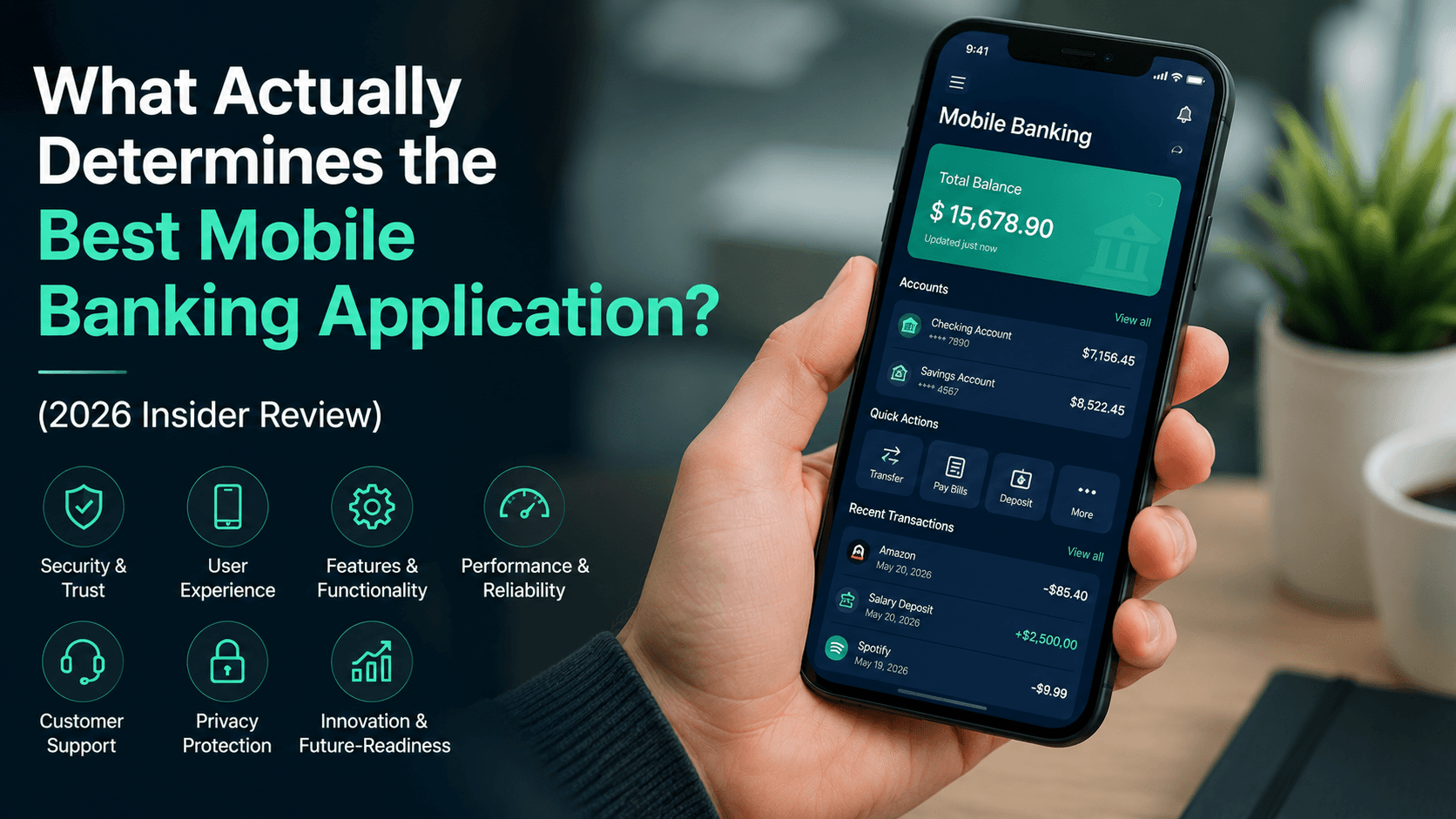
Let’s be completely honest for a second. Most retail banking apps feel like they were designed by a committee of corporate lawyers and compliance officers, rather than actual human beings who need to move money around on the go. They are cluttered, they bury basic features under three layers of menus, and they freeze the moment your cell signal drops to one bar.
But a few standouts have cracked the code. They don't just feel like a digital version of a bank branch; they feel like intuitive software built for modern life.
If you are looking to build or scale a financial product, you can't just copy the old guard. You have to understand the precise intersection of security, speed, and user psychology. As a mobile app development company that looks under the hood of enterprise software daily, we know that the difference between a five-star app and a deleted app comes down to engineering choices, not marketing budgets.
Let’s tear down what the industry leaders are doing right this year.
The Frontrunners: Who Set the Standard?
You don't need a list of fifty local banks. You need to look at the platforms that fundamentally changed how people interact with their money.
1. Chime: The King of Frictionless Onboarding
Chime didn't win the market by offering complex investment portfolios. They won by making the basic stuff incredibly smooth.
- The Reality: Their entire signup flow takes less than three minutes on a phone. The UI is clean, almost sparse, focusing entirely on two numbers: what you have and what you spent.
- The Takeaway: They eliminated the psychological barrier of banking. No hidden fees, no complex jargon. It’s pure utility.
2. Revolut: The Cross-Border Juggernaut
Revolut is a masterclass in handling massive backend complexity without letting the user see the seams.
- The Technical Feat: It switches currencies, tracks global stocks, manages crypto wallets, and issues disposable virtual cards instantly.
- Why it works: Despite the massive feature bloat under the surface, the frontend remains snappy because they prioritize asynchronous data loading. The app doesn't wait for the whole server to respond before showing you your dashboard.
3. Capital One: The Best Legacy Pivot
Most traditional banks struggle to update their infrastructure. Capital One is the rare exception that actually operates like a true tech company. Their mobile app regularly outperforms other major institutions because they stopped viewing the app as a "side project" and treated it as their primary product.
The Invisible Infrastructure: Why Banking Software Is Hard
Building the best mobile banking application isn't like building a standard e-commerce shop. The stakes are infinitely higher. If a retail app glitched for ten seconds, a user loses a shopping cart. If a banking app glitches for ten seconds, people panic about their life savings.
Any elite Mobile app development company will tell you that the real battle happens in the backend integration.
- Legacy Core Banking Systems: Most traditional banks are still running on monolithic backend systems built in the 1980s. The mobile app has to act as a modern translator for this ancient tech. Every time you check a balance, the app has to call an API that speaks to a crumbling main-frame without stalling the user interface.
- Biometric Fail-safes: Security cannot get in the way of usability. The transition from FaceID to the account dashboard needs to happen in milliseconds. If the local encryption handshake takes too long, the user experiences it as "lag."
The 2026 Mobile Banking Checklist
If you are planning a fintech project, run your feature roadmap through this reality check:
- Instant Ledger Updates: If a user taps their debit card at a coffee shop, the push notification should hit their phone before the receipt finishes printing. Delayed data kills user trust.
- Offline-First Querying: What happens when a user opens the app in a subway station with zero service? The app shouldn't show a blank white screen or a spinning loading wheel. It should display their last known balance with a clear timestamp.
- Dynamic Micro-Animations: When money moves from a checking account to a savings goal, there should be immediate visual feedback. It sounds superficial, but those small design cues create a sense of security and control.
Security Standards That Cannot Be Negotiated
Don't let a cutting-edge design mask a weak foundation. If your development team isn't talking about these protocols in the first meeting, find a new team:
- End-to-End Payload Encryption: Data must be encrypted before it ever leaves the device, using transport layers that prevent man-in-the-middle attacks.
- Tokenized API Sessions: The app should never store raw user credentials on the local device storage. Everything should run on short-lived, self-destructing tokens.
- Code Obfuscation: Hackers will try to reverse-engineer your application package binary. Your code needs to be intentionally scrambled before submission to the App Store to prevent malicious tampering.
The Bottom Line
The future of fintech isn't about adding more features; it's about removing more friction. The banks that win are the ones that respect the user’s time. If you’re ready to build a financial tool that competes with the top tier, make sure your dev partner focuses on raw speed, data security, and architectural scale from day one.
Stop trying to copy everyone else's feature list. Figure out the one thing your users hate most about their current bank, and fix that first.