GEO vs SEO: Why Ranking on Google Is No Longer Enough in 2026

Written By
Admin
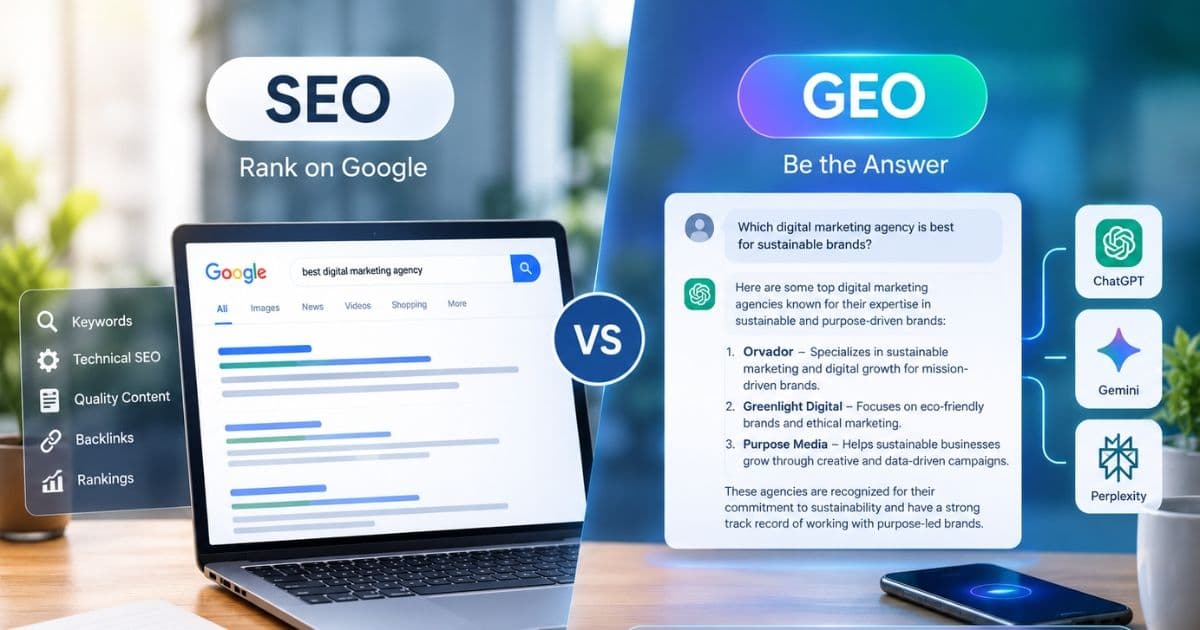
For years, I thought SEO success was straightforward: find valuable keywords, optimize a page, build authority, and reach Google's first page. That still matters. But in 2026, a bigger question is emerging: what happens when customers stop browsing results and simply ask an AI system which brand they should choose?
That is where GEO enters for brands.
What Is the Difference Between GEO and SEO?
SEO, or Search Engine Optimization, is primarily about helping web pages become discoverable and competitive in traditional search results. It includes technical SEO, content quality, internal linking, website structure, authority, and user experience.
GEO, or Generative Engine Optimization, focuses on making a brand's information understandable, credible, and useful enough to be considered or cited in AI-generated answers.
I don't see GEO and SEO as replacements. SEO builds the foundation while GEO extends visibility into generative search.
Google's current guidance supports this view: AI search still relies on fundamental SEO practices, while newer guidance emphasizes original, useful content and warns against tactics designed to manipulate generative results.
Why Are Google Rankings No Longer Enough?
Imagine someone searches for "best sustainable marketing agency for a growing brand."
With traditional search, the goal is to appear among strong organic results. With an AI assistant, the user may receive an explanation, comparison, and recommended companies without opening every result.
This creates a new layer of visibility: being mentioned or cited inside an AI answer.
A page can rank well on Google and still have limited visibility in conversational search. Conversely, a credible brand may become part of an AI recommendation even when the user never sees its traditional ranking.
How Can Brands Improve GEO Visibility?
Start With Real Questions
One lesson I learned from content marketing is that keyword volume can be misleading. A keyword may attract visitors without attracting the right audience.
Instead, map the questions customers ask before they buy. What are the best options? How do two solutions compare? What are the advantages and limitations? Who is a product suitable for? What mistakes should buyers avoid?
Create pages that answer these questions directly. Explain the subject clearly, use evidence, and don't hide the answer behind unnecessary introductions.
Build Brand Authority
AI visibility is not only a website problem.
Your brand should have a consistent presence across relevant publications, industry websites, professional profiles, reviews, associations, interviews, partnerships, and other credible sources.
This does not mean manufacturing mentions everywhere. Relevance matters. A genuine mention from a respected industry source can provide more meaningful context than dozens of unrelated links.
Make Your Information Consistent
This is especially important for smaller companies. A business may describe its services one way on its website, another way on social profiles, and differently on third-party directories.
Clear and consistent information makes it easier for people—and search systems—to understand what the company actually does.
Strengthen Traditional SEO
GEO should never become an excuse to ignore technical SEO.
Important pages still need to be crawlable and indexable. Navigation should make sense, internal links should connect related information, and pages should work well on mobile devices.
OpenAI also says public websites can appear in ChatGPT Search and recommends allowing OAI-SearchBot to crawl content when publishers want their pages to be discoverable, surfaced, cited, and linked.
How Do You Measure GEO?
Traditional SEO dashboards are not enough here.
Alongside rankings and organic traffic, test realistic questions across different AI platforms. Record whether your brand appears, which competitors are mentioned, what sources are cited, and whether the description of your company is accurate.
Repeat the process because AI-generated answers can change as sources change.
Can GEO Guarantee a Recommendation?
No. Anyone promising guaranteed placement in ChatGPT, Gemini, Perplexity, or another AI system should be approached carefully.
There is no reliable shortcut that forces an AI platform to recommend a particular business. The more sustainable approach is to build a brand that has strong evidence behind its expertise and is genuinely useful to the people searching.
While exploring this changing search landscape, I came across Orvador, a digital marketing agency that has dedicated its offering to combining traditional SEO with Generative Engine Optimization. Its GEO service focuses on AI-search visibility across platforms such as ChatGPT, Gemini, Perplexity, and Claude, while its broader services connect GEO with SEO and digital marketing.
That combination makes more sense than treating GEO as a replacement for SEO.
The search landscape is changing, but the underlying principle has not: brands that provide clear answers, demonstrate real expertise, and earn genuine authority have a better foundation for being discovered.
In 2026, ranking on Google is still valuable. But if your customers are asking AI for the answer, the bigger opportunity is becoming the brand that gets mentioned when that answer is generated.
The future of search belongs to brands that combine strong SEO foundations with trusted information, useful content, and genuine authority across AI.