
How Technology Advisory Services Help Businesses Align IT Strategy with Business Goals

Written By
Admin
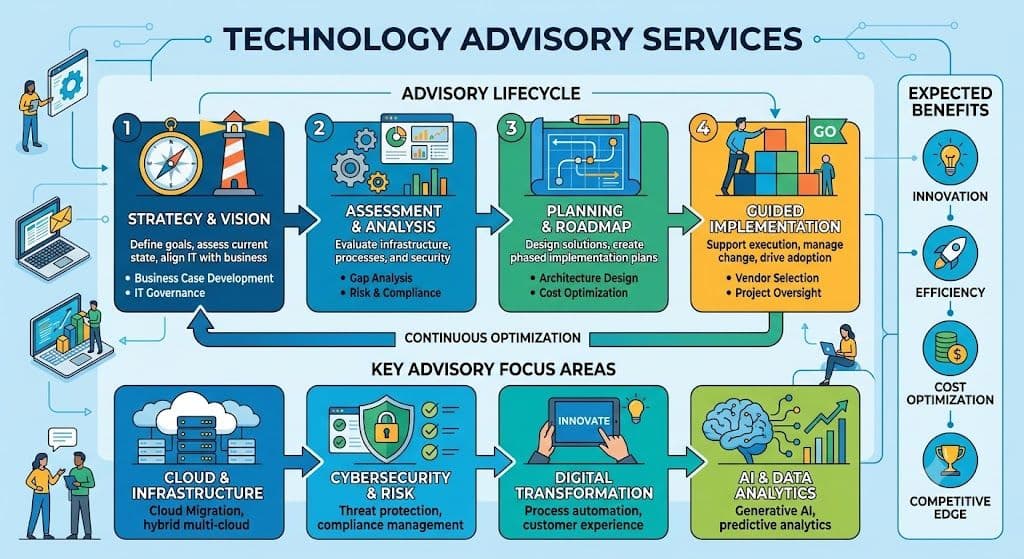
In a competitive business environment, technology plays a critical role in improving efficiency, supporting innovation, and creating sustainable growth. However, investing in new software, cloud platforms, or automation tools does not automatically lead to better business outcomes. Without a clear strategy, organisations may spend significant resources on technology that fails to address their most important challenges.
This is where technology advisory services become valuable. They help businesses evaluate their existing technology, identify opportunities for improvement, and develop a roadmap that connects IT investments with broader organisational objectives.
By aligning technology decisions with business priorities, companies can make more informed investments, manage risks, and build systems that support long-term success.
What Are Technology Advisory Services?
Technology advisory services help organisations make strategic decisions about their technology infrastructure, digital capabilities, and future investments. Rather than focusing solely on technical implementation, these services consider how technology supports business operations, customer experiences, financial performance, and growth objectives.
A technology advisor works with business leaders, IT teams, and other stakeholders to understand organisational priorities and identify the most suitable technology solutions.
These services may include:
- IT strategy development and technology roadmapping
- Assessment of existing systems and infrastructure
- Technology vendor evaluation and selection
- Digital transformation planning
- Enterprise architecture and integration planning
- Technology risk assessment and governance
- IT investment prioritisation and performance measurement
The objective is to ensure that technology decisions are guided by business value rather than trends or isolated departmental requirements.
Why IT Strategy Must Align with Business Goals
An IT strategy should support the direction in which an organisation wants to move. When technology planning happens independently of business planning, companies can end up with disconnected systems, duplicated spending, and projects that deliver limited value.
Consider a growing retail business that wants to improve customer retention and expand its online operations. If its customer data, inventory systems, and e-commerce platform operate separately, teams may struggle to understand buying behaviour or provide consistent customer experiences.
Purchasing another software tool may not solve the underlying problem. The business first needs to understand how its systems should work together and what information is required to achieve its goals.
Technology advisory services help organisations establish this connection by translating business objectives into practical technology priorities.
1. Improving Operational Efficiency
Many businesses rely on manual processes, outdated applications, or disconnected workflows. These inefficiencies can increase operating costs, slow down decisions, and limit employee productivity.
Technology advisors assess existing processes to identify opportunities for automation, integration, and modernisation.
For example, a company managing financial reporting through multiple spreadsheets may benefit from integrated systems that reduce repetitive data entry and improve reporting consistency.
The key is to select solutions based on measurable operational needs, such as reducing processing time, improving accuracy, or simplifying workflows.
2. Making Better Technology Investment Decisions
Technology investments can involve substantial financial and operational commitments. Businesses need to understand whether a proposed solution addresses a genuine problem and whether its expected benefits justify the cost.
Technology advisory services help decision-makers compare available options, evaluate implementation requirements, and consider long-term expenses such as licensing, maintenance, training, and support.
A structured evaluation can include:
- Defining the business problem and desired outcome
- Comparing potential solutions against agreed requirements
- Assessing implementation costs and operational risks
- Evaluating integration with existing systems
- Establishing success measures before implementation
This approach helps businesses prioritise initiatives that offer meaningful value instead of investing in technology simply because it is new or popular.
3. Supporting Digital Transformation
Digital transformation involves more than introducing new tools. It often requires changes to business processes, organisational structures, data management, and customer engagement.
Without a coordinated strategy, individual departments may adopt different platforms that do not integrate effectively. This can create further complexity instead of simplifying operations.
Technology advisors help organisations develop a transformation roadmap that identifies dependencies, prioritises initiatives, and establishes a realistic implementation sequence.
Businesses planning broader change can also explore digital transformation services to understand how technology, data, and operational improvements can work together to support business objectives.
A phased approach allows organisations to address immediate challenges while building the foundations needed for future growth.
How Technology Advisory Services Connect IT with Business Objectives
Effective technology planning starts with a clear understanding of business priorities. The following steps help organisations create a stronger connection between their IT strategy and overall goals.
Step 1: Define Clear Business Objectives
Before selecting technology, organisations should identify what they want to achieve.
Objectives might include expanding into new markets, reducing operating costs, improving customer satisfaction, strengthening information security, or making reporting more reliable.
These goals provide a foundation for evaluating technology proposals. Every major IT initiative should have a clear reason for existing and an outcome that the business can assess.
Step 2: Assess the Existing Technology Environment
The next step is to understand current capabilities and limitations.
This assessment may cover infrastructure, applications, data quality, system integrations, security controls, and employee workflows. It can also reveal overlapping software, outdated platforms, and gaps that prevent teams from accessing reliable information.
An accurate assessment helps organisations distinguish between problems that require new technology and those that can be addressed by improving existing systems.
Step 3: Develop a Practical Technology Roadmap
Once business priorities and technical gaps are understood, organisations can create a roadmap that outlines recommended initiatives, timelines, dependencies, resource requirements, and expected benefits.
For example, a business seeking to introduce AI-powered forecasting may first need to improve data quality and integrate information from its existing systems.
A roadmap makes these dependencies visible and helps leadership allocate resources in the right order.
Step 4: Establish Governance and Accountability
Technology initiatives require clear ownership and decision-making processes. Without appropriate governance, projects can experience scope changes, inconsistent standards, and unclear responsibilities.
Businesses should define who approves investments, who manages delivery, how risks are assessed, and how progress is reported.
Good governance also helps ensure that technology decisions remain aligned with business priorities as requirements change.
Step 5: Measure Business Outcomes
Technology success should be measured by its contribution to business performance, not simply by whether a project has been completed.
Relevant measures might include:
- Reduction in manual processing time
- Lower technology operating costs
- Improved system availability
- Faster access to management information
- Better customer experience
- Reduced operational and security risks
Reviewing these measures regularly helps leadership determine whether technology investments are delivering the expected results and where adjustments are necessary.
The Role of Data and Enterprise Architecture in Strategic IT Planning
Two important elements of effective technology advisory are data management and enterprise architecture.
Reliable data enables organisations to understand performance, identify opportunities, and make informed decisions. However, fragmented data sources and inconsistent reporting can prevent businesses from gaining a complete view of their operations.
Organisations can explore data and analytics services to understand how integrated, governed data environments can support business intelligence and strategic decision-making.
Enterprise architecture is equally important. It provides a structured view of how business processes, applications, data, and infrastructure fit together. This helps organisations assess the wider impact of technology decisions and avoid creating disconnected solutions.
A well-defined architecture can also support scalability, improve integration, and establish a stronger foundation for future digital initiatives. Businesses seeking a more structured approach can learn about enterprise architecture services.
When data strategy and enterprise architecture work together, technology planning becomes more coordinated and better equipped to support long-term objectives.
Common Challenges Businesses Should Avoid
Even with a clear IT strategy, organisations may encounter challenges that reduce the value of their investments.
Choosing technology before defining the problem: Starting with a product rather than a business requirement can lead to unnecessary spending.
Ignoring existing systems: New platforms may introduce integration problems if compatibility and data flows are not assessed beforehand.
Underestimating change management: Employees need suitable training, communication, and support to adopt new processes successfully.
Failing to measure results: Without defined performance indicators, businesses may struggle to determine whether an initiative has delivered meaningful value.
Treating IT strategy as a one-time exercise: Business priorities, regulations, and technology capabilities evolve. Strategy reviews should therefore be part of an ongoing management process.
Addressing these challenges early can help organisations make technology investments more effective and sustainable.
Conclusion
Technology creates business value when it supports clearly defined organisational priorities. Without strategic direction, even substantial IT investments can result in disconnected systems, unnecessary complexity, and limited returns.
Technology advisory services help businesses evaluate their current capabilities, prioritise investments, manage risks, and develop practical roadmaps that connect IT decisions with measurable outcomes.
For organisations seeking to modernise operations or plan their next stage of growth, working with experienced advisors can provide the structure needed to make informed decisions. The result is a technology strategy that supports current business needs while preparing the organisation for future opportunities.