
How B2B Companies Can Use Social Media Marketing to Generate High-Value Business Opportunities

Written By
Admin
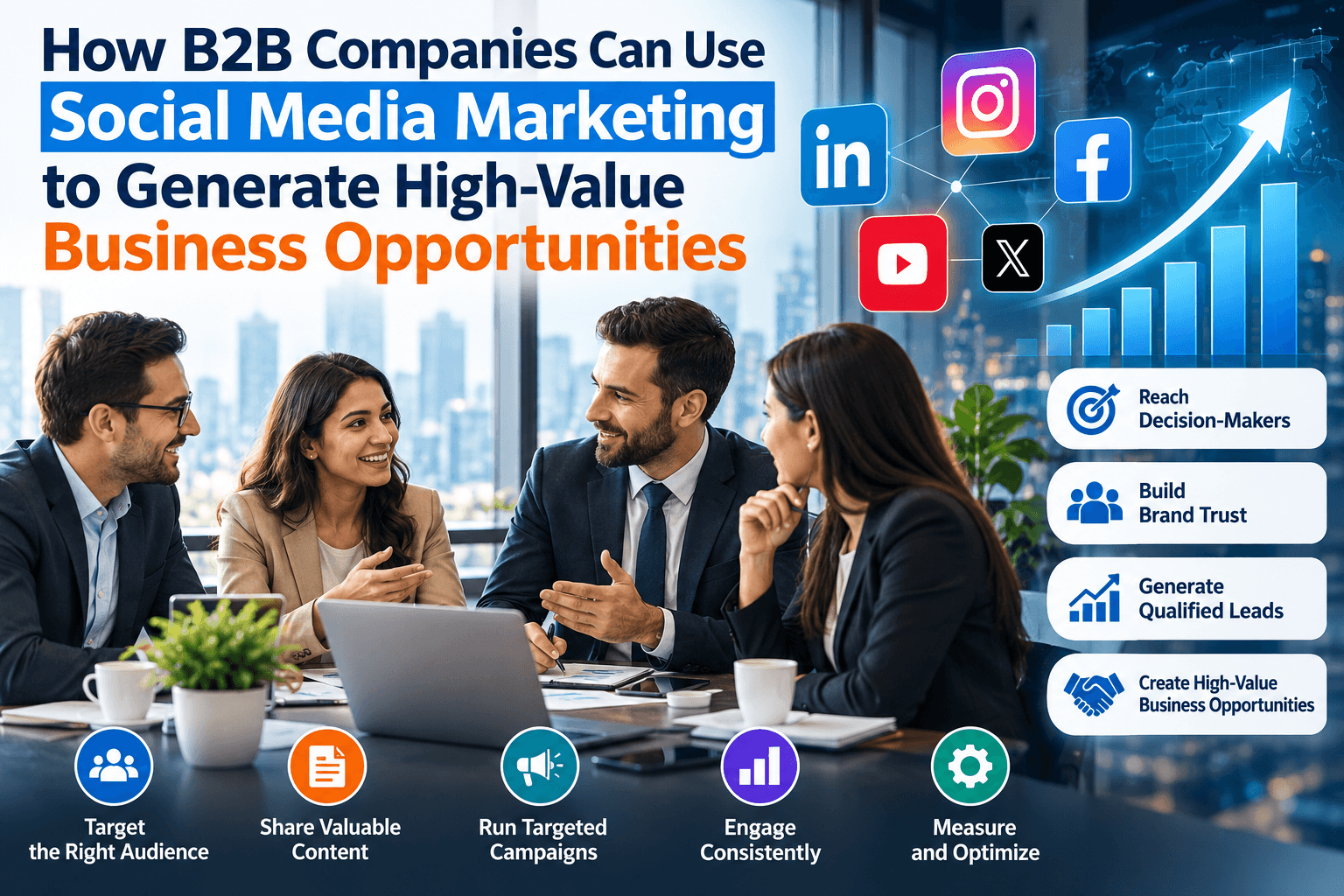
Social media marketing has become an effective way for business-to-business (B2B) companies to connect with decision-makers, build brand awareness, and generate qualified business opportunities. Platforms such as LinkedIn, Facebook, Instagram, and YouTube help businesses demonstrate expertise, share industry insights, and develop relationships with potential clients.
Unlike B2C marketing, B2B marketing often involves longer sales cycles, multiple stakeholders, and decisions based on trust and measurable business value. Companies therefore need a strategy that prioritizes meaningful engagement and qualified leads rather than simply increasing followers or likes.
By combining educational content, targeted advertising, consistent engagement, and performance tracking, B2B organizations can turn social media into a valuable channel for long-term business growth.
1. Identify Your Ideal B2B Audience
Understanding the target audience is the first step toward generating valuable opportunities through social media. B2B companies should identify the industries, company sizes, job roles, and business challenges most relevant to their offerings.
For example, a software development company might target IT managers, technology directors, and business owners, while a digital marketing agency could focus on founders, marketing managers, and sales leaders.
LinkedIn is particularly useful for reaching professional audiences through industry discussions and targeted campaigns. Businesses can also use customer feedback, sales conversations, and website analytics to understand their prospects' requirements.
Developing detailed buyer personas allows companies to create relevant content and reach people who are more likely to become qualified customers.
2. Choose the Right Social Media Platforms
Each social media platform serves different purposes, so businesses should focus on the channels that best match their audience and objectives.
LinkedIn supports professional networking, thought leadership, B2B advertising, and lead generation. YouTube is useful for product demonstrations, educational videos, and customer interviews. Facebook can support retargeting and community engagement, while Instagram helps businesses communicate their brand identity through visual content.
Companies should evaluate where their decision-makers are most active instead of trying to maintain an equally strong presence on every platform.
A focused strategy across two or three relevant channels can help businesses publish consistently, improve engagement, and use their resources more efficiently.
3. Publish Educational and Problem-Solving Content
B2B buyers often research solutions before contacting a service provider. Social media gives companies an opportunity to answer important questions and demonstrate expertise before a sales conversation begins.
Useful content formats include industry insights, practical guides, case studies, checklists, short videos, and expert commentary. A cybersecurity company, for instance, could explain common security risks, while a marketing agency might share strategies for improving online visibility and generating qualified leads.
Businesses can also repurpose existing blog articles into LinkedIn posts, infographics, and video clips to extend their reach.
The objective is to provide genuine value rather than repeatedly promoting products or services. Helpful content builds credibility, encourages meaningful engagement, and gives potential customers a reason to learn more about a company.
4. Build Thought Leadership and Professional Trust
High-value B2B opportunities frequently develop through sustained relationships and demonstrated expertise. Thought leadership allows companies to establish credibility by sharing informed perspectives, industry knowledge, and practical lessons.
Business leaders can participate in professional discussions, publish original insights, comment on industry developments, and explain how their teams solve real business problems.
For digital marketing companies, emerging technologies also offer opportunities to educate potential customers. Businesses researching chatgpt seo services may want to understand how brands can improve their discoverability in AI-powered search experiences. Similarly, ai answer optimization services can be discussed in the context of helping businesses make their content clearer, more useful, and easier for AI-powered platforms to interpret.
By explaining these services accurately and sharing practical examples, companies can demonstrate their understanding of evolving digital trends. Consistent expertise helps build trust and positions a business as a valuable resource rather than just another service provider.
5. Use Targeted Campaigns to Reach Decision-Makers
Organic content helps businesses establish a presence, while paid social media campaigns can expand their reach among carefully selected audiences. Depending on the platform, B2B advertisers may target professionals using factors such as job function, seniority, industry, and company characteristics.
Campaigns should have specific objectives, such as generating consultation requests, promoting a webinar, collecting registrations, or encouraging prospects to download an industry report.
Dedicated landing pages can support these campaigns by explaining the offer, highlighting its benefits, and providing a clear next step. A relevant call to action makes it easier for interested users to move from social media engagement to a business inquiry.
Companies should measure campaign success using qualified leads, conversion rates, cost per lead, and sales opportunities generated. These metrics provide a clearer picture of business value than impressions and clicks alone.
6. Integrate Social Media With SEO and Content Marketing
Social media and search engine optimization can complement one another when they support a consistent content strategy. Businesses can distribute search-focused articles through social channels, use audience questions to identify new content topics, and direct interested readers toward relevant service pages.
For example, an article about improving AI search visibility can be transformed into a LinkedIn carousel, a short educational video, and a series of discussion posts.
Content about chatgpt seo services and ai answer optimization services can also address questions that businesses may have about AI-driven discovery. The content should explain the subject clearly, avoid unsupported promises, and direct readers to resources that provide additional information.
Social media engagement does not automatically improve organic search rankings. Its practical value lies in expanding content distribution, increasing brand recognition, attracting relevant visitors, and creating opportunities for further engagement.
7. Nurture Leads Through Meaningful Engagement
Not every potential client will be ready to purchase after reading a single post. B2B companies should maintain relationships by answering questions, responding to relevant comments, sharing useful resources, and participating in industry conversations.
When a prospect demonstrates genuine interest, a personalized follow-up can help continue the discussion without making the interaction feel overly promotional.
Businesses can also offer webinars, downloadable guides, research reports, and consultations to encourage interested users to take the next step. With appropriate consent, marketing teams can use customer relationship management (CRM) systems and email campaigns to maintain communication throughout the buying journey.
Consistent and relevant engagement keeps the business visible while helping prospects make informed decisions.
8. Measure Results and Optimize Performance
A successful social media strategy requires regular measurement and improvement. Companies should establish clear objectives and select metrics that reflect their business goals.
Reach, engagement, website visits, and content downloads help measure audience interest. More commercially relevant indicators include qualified leads, booked meetings, sales pipeline contribution, and revenue generated.
Businesses can use platform analytics, website tracking, and CRM data to understand which campaigns and content formats produce meaningful opportunities. Testing different headlines, audiences, creative formats, and calls to action can reveal what works best.
Regular performance reviews also help identify problems, such as high engagement but few inquiries or a large volume of leads with low conversion potential. By using these insights to refine targeting and messaging, companies can improve marketing efficiency and focus on the activities that contribute to growth.
Conclusion
Social media marketing can help B2B companies generate high-value business opportunities by reaching relevant decision-makers, sharing educational content, building professional trust, and nurturing relationships throughout the buying journey. By choosing appropriate platforms, investing in thought leadership, running targeted campaigns, integrating social media with SEO, and tracking meaningful performance indicators, businesses can move beyond vanity metrics and focus on qualified leads, sales opportunities, and sustainable growth.
eBranding Studio helps businesses strengthen their online presence through digital marketing services, including search engine optimization, generative engine optimization, answer engine optimization, social media marketing, performance marketing, and website development. By combining strategic planning with audience-focused content and digital growth initiatives, eBranding Studio aims to help brands improve their visibility and attract relevant business opportunities.