
Einstein's IQ and Emotional Intelligence: What Made Him Exceptional

Written By
Admin
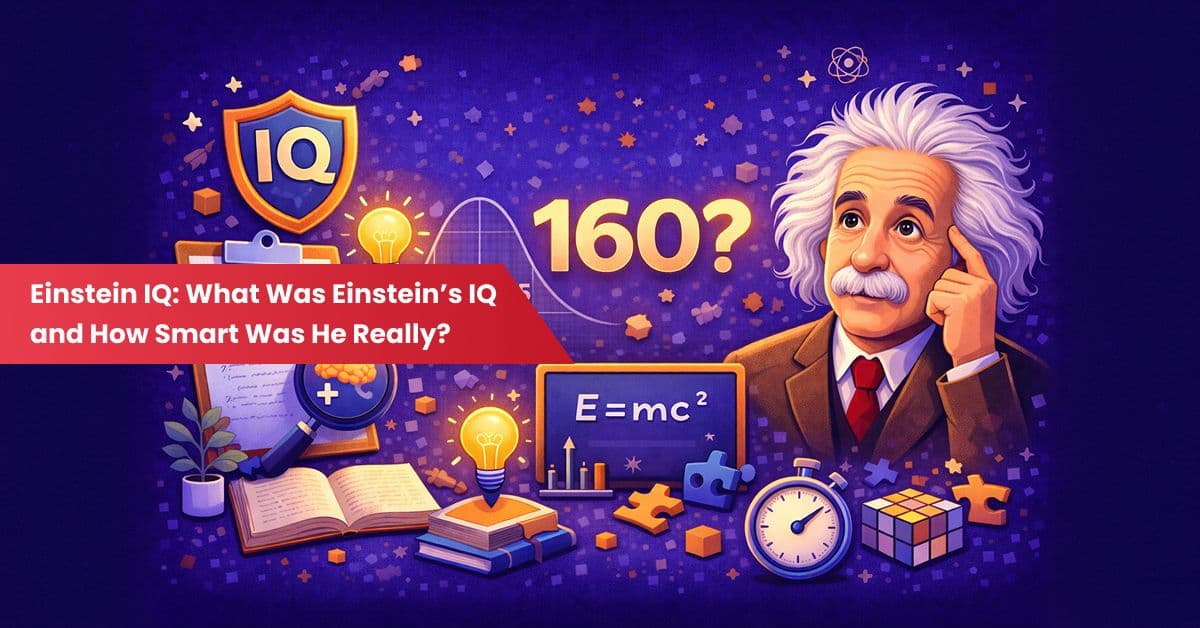
Albert Einstein is widely regarded as one of the greatest scientific thinkers in history. His theories transformed physics and changed the way people understand space, time, gravity, light, and energy. His name has become so closely associated with intelligence that the word "Einstein" is often used as a synonym for genius.
This reputation has led to decades of fascination with Einstein's IQ. Many websites claim that he had an IQ of 160, while some sources suggest even higher scores. Yet there is an important fact that is often overlooked: there is no reliable historical record showing that Einstein ever took a standardized IQ test and received an official score.
His actual IQ is therefore unknown. The commonly quoted figure of 160 is a retrospective estimate, not a documented test result.
But IQ is only one part of the larger question of what made Einstein exceptional. His achievements also raise interesting questions about creativity, curiosity, persistence, social awareness, and emotional intelligence. While emotional intelligence is difficult to assess historically, examining Einstein's life can help us understand why genius is much more complicated than a single number.
What Was Einstein's IQ?
The most accurate answer is that nobody knows Einstein's actual IQ.
The figure of 160 has become extremely popular in articles, online quizzes, social media posts, and discussions about famous geniuses. Other sources have suggested scores of 180, 190, or higher.
However, there is no verified test report supporting these numbers.
Einstein lived from 1879 to 1955, and intelligence testing existed during parts of his lifetime. However, modern IQ testing developed through different tests, scoring systems, and statistical methods. Without a documented assessment, it is impossible to know exactly how Einstein would have performed on a modern intelligence test.
This does not mean there is any reason to doubt his extraordinary intellectual abilities. His scientific achievements provide extensive evidence of exceptional reasoning and creativity. They simply cannot be converted into an exact IQ score.
Therefore, when discussing Einstein's IQ, it is more accurate to describe 160 as a popular estimate rather than a confirmed historical fact.
Why Is Einstein Associated With an IQ of 160?
The popularity of the 160 estimate probably comes from attempts to express Einstein's extraordinary intellectual reputation numerically.
An IQ of 160 would be extremely high on a modern IQ scale. With an average score of 100 and a standard deviation of approximately 15, an IQ of 160 would be roughly four standard deviations above the mean.
That makes the number sound consistent with the public image of Einstein as an extraordinary genius.
However, a person's achievements cannot be used to calculate an exact IQ. Scientific achievement depends on many factors beyond the cognitive abilities measured by intelligence tests.
Education, motivation, creativity, persistence, knowledge, opportunity, and specialized expertise can all influence achievement.
For this reason, the number 160 should be treated cautiously.
What Does IQ Actually Measure?
IQ tests are designed to measure specific cognitive abilities. Depending on the assessment, these can include logical reasoning, verbal comprehension, working memory, processing speed, numerical reasoning, and visual-spatial skills.
These abilities are important, but they do not represent every form of intelligence.
A person can be excellent at abstract reasoning without necessarily being exceptional at communication, social interaction, creativity, or emotional regulation.
This distinction becomes particularly interesting when discussing Einstein.
His scientific accomplishments demonstrate extraordinary intellectual ability, but they do not tell us everything about his personality, relationships, or emotional skills.
What Is Emotional Intelligence?
Emotional intelligence generally refers to the ability to recognize, understand, use, and manage emotions effectively. It can involve several related skills, including awareness of one's own emotions, understanding other people's feelings, managing emotional reactions, and handling interpersonal relationships.
Unlike IQ, emotional intelligence is not represented by one universally accepted measurement system.
Different researchers and psychological models define and assess emotional intelligence in different ways.
This makes it particularly difficult to determine Einstein's emotional intelligence retrospectively.
We have historical accounts, letters, biographies, and statements about his personality, but we do not have a standardized emotional intelligence assessment completed by Einstein.
Therefore, claims that Einstein had either exceptionally high or low emotional intelligence should be approached carefully.
Einstein's Curiosity and Intellectual Independence
One characteristic that clearly contributed to Einstein's success was curiosity.
He was fascinated by fundamental questions about the physical world and was willing to explore ideas that challenged conventional assumptions.
His approach to science was not simply about memorizing existing knowledge. He wanted to understand why things worked.
This intellectual curiosity helped him investigate questions involving light, motion, space, and time.
Another important characteristic was intellectual independence.
Einstein was comfortable questioning established scientific ideas. His theory of special relativity challenged traditional assumptions about space and time, while general relativity introduced a revolutionary new understanding of gravity.
This willingness to question conventional thinking was essential to his scientific achievements.
Creativity Was Central to Einstein's Genius
IQ can measure certain forms of reasoning, but creativity is another major component of intellectual achievement.
Einstein's scientific work demonstrates remarkable conceptual creativity.
One of his most famous methods was the use of thought experiments. He imagined hypothetical situations and considered what they would imply about physical laws.
This allowed him to explore difficult scientific questions through imagination and logical reasoning.
Creativity is difficult to measure with conventional IQ tests. A test can ask someone to identify the correct answer to a problem, but scientific creativity may involve discovering a problem that nobody has previously recognized or developing an entirely new framework for understanding it.
Einstein excelled at this kind of conceptual innovation.
Persistence Also Mattered
Genius is sometimes portrayed as effortless intelligence, but Einstein's career demonstrates the importance of sustained effort.
Major scientific discoveries require extensive study, mathematical work, revision, and reflection.
Einstein developed his ideas over many years. His achievements were not simply the result of possessing a high level of natural ability.
He also needed knowledge, discipline, intellectual persistence, and the willingness to continue working on difficult questions.
This is an important distinction when thinking about Einstein's IQ.
Even if the popular estimate of 160 were accurate, the number alone would not explain his accomplishments. Cognitive ability provided part of the foundation, but his achievements also depended on how he applied that ability.
What About Einstein's Emotional Intelligence?
Determining Einstein's emotional intelligence is much harder.
Historical accounts portray a complex individual with strengths and weaknesses. He maintained friendships and professional relationships, corresponded extensively with colleagues, and participated in public discussions about science and politics.
At the same time, biographies and historical records also describe difficulties in some personal relationships.
This complexity is important because emotional intelligence is not an all-or-nothing characteristic.
Someone can demonstrate empathy and understanding in certain situations while struggling with communication or relationships in others.
It would therefore be inappropriate to label Einstein as either emotionally intelligent or emotionally unintelligent based on isolated stories.
Scientific Genius Does Not Require Perfect Social Skills
Another common misconception is that a genius must excel in every area of life.
That is not true.
A person can possess exceptional mathematical reasoning while having ordinary or even significant weaknesses in other areas.
Similarly, someone can have excellent social skills without being exceptionally strong in abstract reasoning.
Human abilities are multidimensional.
Einstein's scientific achievements demonstrate extraordinary intellectual capability, but they do not imply that he was perfect in communication, relationships, or emotional understanding.
This is one reason why focusing entirely on einstein's iq can create an incomplete picture of his personality.
Einstein's Communication Skills
Although Einstein was primarily known as a theoretical physicist, communication was an important part of his work.
Scientific ideas have little influence if they cannot be communicated to other researchers and eventually to the wider public.
Einstein wrote extensively, gave lectures, corresponded with scientists, and discussed scientific and philosophical questions with other thinkers.
His ability to communicate complicated ideas helped spread his theories beyond specialist scientific circles.
However, effective communication should not automatically be interpreted as proof of high emotional intelligence. The two abilities overlap in some situations but are not identical.
Communication involves language and social skills, while emotional intelligence includes recognizing and managing emotions.
Why Einstein's Personality Matters
Einstein's personality contributed to his public image.
He was known for his unconventional appearance and individualistic approach to life. His refusal to conform to conventional expectations helped create the image of the independent genius.
This image can sometimes obscure the more ordinary human characteristics behind the famous scientist.
Einstein experienced professional setbacks, personal difficulties, political challenges, and changing relationships throughout his life.
Understanding these experiences makes his story more realistic.
He was not simply a brain producing equations. He was a complex person whose intellectual achievements emerged from a combination of abilities, interests, circumstances, and personal characteristics.
IQ, Emotional Intelligence, and Creativity
A useful way to understand Einstein is to consider several forms of ability together.
His theoretical work demonstrates exceptional reasoning ability.
His thought experiments demonstrate creativity and imagination.
His scientific career demonstrates persistence and intellectual independence.
His correspondence and professional relationships demonstrate that he possessed the ability to communicate and collaborate, although his interpersonal life was complex.
These qualities interacted with one another.
This is why trying to explain Einstein entirely through Einstein's IQ misses part of the story.
A high IQ may help someone understand difficult concepts, but it does not automatically produce groundbreaking ideas.
Creativity helps generate new ideas. Curiosity motivates exploration. Persistence helps develop those ideas. Communication allows them to reach other people.
Exceptional achievement can emerge from the combination.
Can Genius Really Be Measured?
The Einstein example suggests that genius cannot be completely captured by a single test score.
IQ tests can provide valuable information about certain cognitive abilities. They can help identify patterns of reasoning and other mental skills.
However, genius involves more than test performance.
Scientific genius may include originality, creativity, curiosity, persistence, imagination, specialized knowledge, and the ability to recognize important questions.
Emotional intelligence adds another dimension by considering how people understand and manage emotions and relationships.
Neither IQ nor emotional intelligence alone can explain everything about an extraordinary individual.
What Made Einstein Exceptional?
The most compelling explanation for Einstein's success is not a mysterious IQ number.
It was the combination of intellectual ability and the way he used it.
He was curious about fundamental questions. He was willing to challenge established assumptions. He developed unusual thought experiments. He worked persistently on complex problems. He possessed deep knowledge of mathematics and physics and used that knowledge creatively.
These qualities helped him produce ideas that transformed science.
Whether his actual IQ was 150, 160, or another number is ultimately impossible to determine. His documented achievements are far more informative.
Final Thoughts
The question of Einstein's IQ remains fascinating, but his exact score is unknown. The popular estimate of 160 is not supported by a verified standardized IQ test, so it should be treated as an estimate rather than a historical fact.
More importantly, Einstein's genius cannot be reduced to IQ.
His achievements reflected a combination of abstract reasoning, creativity, curiosity, imagination, persistence, knowledge, and intellectual independence. Emotional intelligence may also have played a role in aspects of his communication and relationships, although it is impossible to assign him a reliable emotional intelligence score today.
Einstein's story reminds us that exceptional human ability is multidimensional. IQ can measure certain forms of cognitive performance, but genius involves much more than solving problems correctly on a standardized test.
The most meaningful evidence of Einstein's exceptional mind is the work he left behind. His theories changed our understanding of the universe and continue to influence science more than a century later.
Ultimately, the question is not simply how high Einstein's IQ might have been. The more interesting question is how he used his abilities. His curiosity led him to ask profound questions, his creativity helped him imagine new possibilities, and his persistence allowed him to turn those ideas into scientific theories that changed the world.