
Hire Next.js Developers, Python Developers and MERN Teams: Top Companies 2026

Written By
Admin
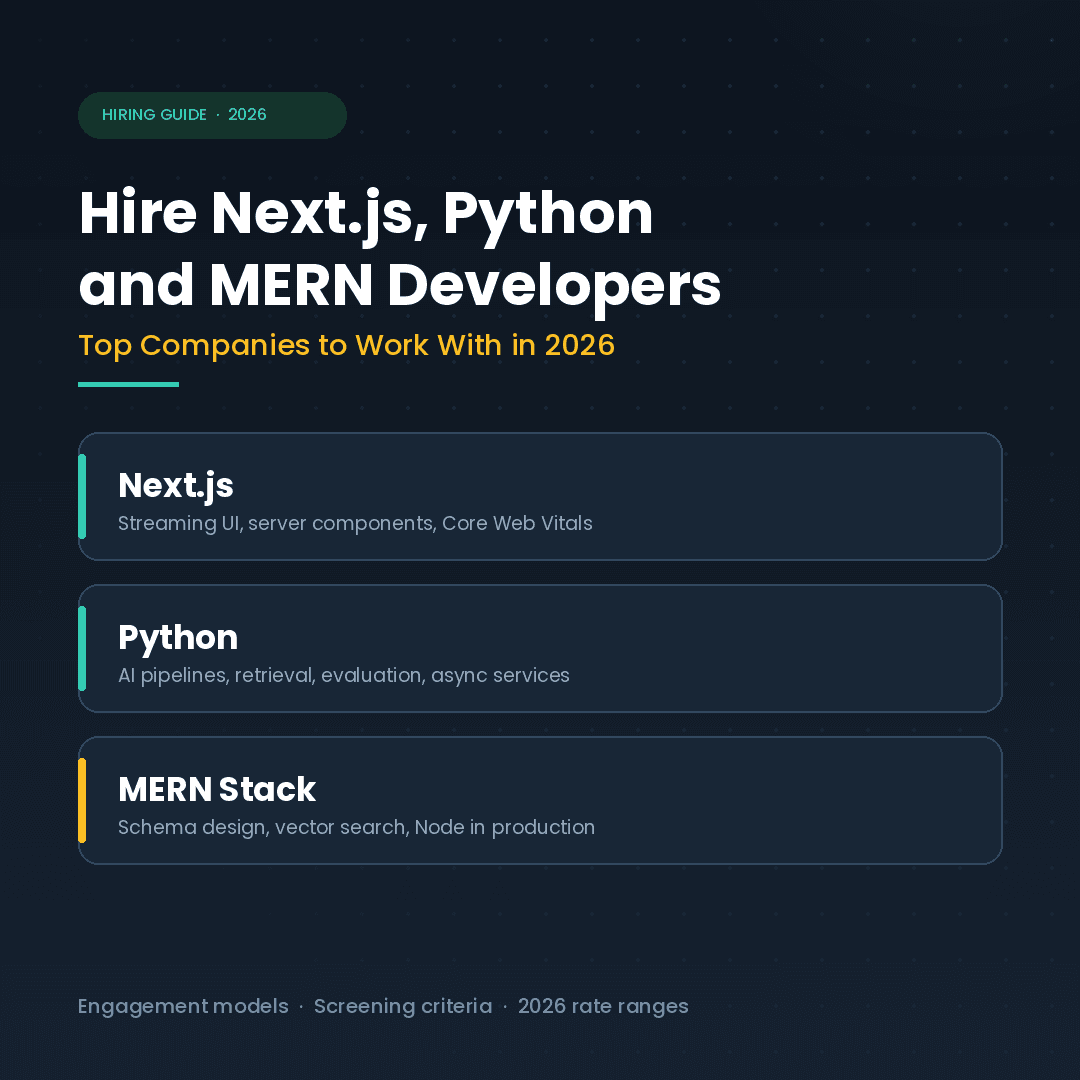
Hiring engineers in 2026 looks different than it did two years ago. The tools changed, the team shapes changed, and the questions that separate a good development partner from an expensive one changed with them.
If you are planning to hire Next.js developers, Python developers or a MERN stack team this year, the decision is no longer just about hourly rate and availability. It is about whether the team can work alongside AI tooling without producing code nobody can maintain, and whether they can connect what they build to the systems your business already runs.
This guide covers the hiring models available, what to screen for in each stack, current rate ranges, and the contract terms that matter more than the headline price.
Quick Answer: How Should You Hire Developers in 2026?
Choose your engagement model first, then the stack team. Use staff augmentation when you have internal technical leadership and need capacity. Use a dedicated team when you need a product built and maintained but have no engineering management. Use fixed-scope delivery only when requirements are genuinely stable. For any project involving AI features, hire a partner that covers Python for the pipeline layer and Next.js or MERN for the application layer, because splitting those across vendors is where most timelines slip.
What Actually Changed About Developer Hiring in 2026
AI-Assisted Development Compressed Team Sizes
A four-person team in 2026 ships what a seven-person team shipped in 2023. That sounds like a straightforward cost saving, and sometimes it is. The complication is that AI-assisted output raises the value of code review and architectural judgment while lowering the value of raw typing speed.
The practical hiring consequence: senior-to-junior ratios matter more than headcount. A proposal offering ten developers at an attractive blended rate is often worse value than five engineers with real review discipline. Ask any prospective partner how they review AI-assisted code and what their rejection rate looks like.
Agentic AI Pushed Integration Work Into Ordinary Projects
Agentic systems, meaning software that plans multi-step tasks and calls tools to complete them, are now appearing in routine business applications rather than dedicated AI products. A customer portal now includes a support assistant. An internal dashboard includes a natural language query layer.
This means integration skills are no longer confined to specialist AI teams. When you hire Next.js developers or a MERN stack development company today, you should expect basic competence in retrieval systems, streaming interfaces and token cost management, even if the brief is a conventional web application.
Enterprise Adoption Raised the Governance Bar
As AI features moved into production, procurement and legal teams caught up. Data residency, model provider terms, audit logging and access control are now standard contract discussion points rather than afterthoughts. Development partners who cannot answer governance questions clearly will slow your approval cycle by weeks.
Distributed Delivery Became Normal Rather Than Exceptional
Time zone overlap is now a negotiated term rather than an assumption. Four hours of overlap is workable for most teams. Two hours is workable only with unusually strong written communication practices. Zero overlap requires asynchronous discipline that most organizations do not have.
Three Ways to Hire: Which Model Fits Your Situation
Staff Augmentation
You add individual developers to your existing team. They report into your technical leadership, work in your repositories and follow your processes.
This works when you already have an engineering manager or lead architect who can direct the work. It fails when companies use it as a substitute for technical leadership, which produces a group of capable individuals with no shared direction.
Typical use case: your roadmap needs two more React engineers for eight months.
Dedicated Development Team
You engage a team including its own lead, and the partner handles internal coordination, code review and delivery management.
This suits organizations without in-house engineering leadership, or those adding a product line outside their existing team's domain. The tradeoff is less granular control and a real dependency on the partner's internal standards, which is why reference checks matter more in this model than any other.
Typical use case: you are a non-technical founder or a business unit building a product with no internal engineering function.
Fixed-Scope Project Delivery
You define requirements, agree a price and receive a defined deliverable.
Fixed scope works when requirements are genuinely stable and well understood. It works badly for AI features, because the discovery process routinely changes what should be built. If you are exploring what an AI capability should do, a fixed-price contract will either produce change orders or a product built to an outdated specification.
Typical use case: a marketing site rebuild, a defined migration, a well-specified integration.
How to Hire Next.js Developers: What to Screen For
Next.js remains the default framework for production React applications, and the screening bar has moved past basic familiarity.
Ask candidates to explain when they would use a server component versus a client component, and why. The answer reveals whether they understand the rendering model or are copying patterns. Ask how they handle streaming responses, since any AI-adjacent interface requires it. Ask about caching behavior, which is the single most common source of production surprises in Next.js applications.
For agencies, ask to see a Core Web Vitals report from a live client project rather than a portfolio screenshot. Performance claims are easy to make and simple to verify. If you are comparing Next.js development companies, rendering strategy and measured performance are the two filters that separate the shortlist quickly.
How to Hire Python Developers: What to Screen For
Python is where most AI integration work happens, which has changed what a good Python hire looks like.
Framework familiarity is table stakes. What distinguishes strong candidates is how they handle non-deterministic systems: testing strategies for output that varies between runs, background job architecture for long-running tasks, asynchronous request handling under load, and reproducible dependency management.
Ask directly how they would test a feature whose output changes each time it runs. Engineers who have shipped AI systems have a considered answer involving evaluation datasets and acceptance thresholds. Engineers who have not will describe conventional unit tests, which do not apply.
For data-heavy roles, ask about pipeline failure handling. Any system moving data between sources will fail partially, and how a developer thinks about partial failure tells you a great deal about their production experience.
How to Hire MERN Stack Developers: What to Screen For
MERN remains widely used for internal tooling, marketplaces and applications where document-shaped data fits the domain better than rigid relational schemas.
The screening question that matters most in 2026 is schema design. MongoDB gives developers enough freedom to build something that works at ten thousand records and collapses at ten million. Ask a candidate to walk through how they would model a specific relationship in your domain and explain their embedding versus referencing decision. Vague answers here predict expensive rewrites later.
Second, ask about vector search. MongoDB now supports it natively, which means teams building AI features can keep retrieval infrastructure alongside application data rather than running a separate vector database. A MERN team that knows this can deliver AI functionality without adding operational overhead. A team that does not will propose a more complicated architecture than you need.
Third, ask about Node process management: clustering, memory profiling and graceful shutdown. These are unglamorous and they determine whether your application stays up. When you evaluate companies to hire MERN stack developers, combined depth across the data layer and the AI layer is what separates the useful shortlist from the long one.
Developer Rate Ranges in 2026
Rates vary by region, seniority and engagement length. The ranges below are indicative starting points for negotiation rather than fixed pricing, and you should verify against current quotes in your own market.
- North America and Western Europe: roughly 90 to 180 US dollars per hour for senior engineers through established firms.
- Eastern Europe: roughly 45 to 85 dollars per hour.
- India and South Asia: roughly 25 to 55 dollars per hour.
- Latin America: roughly 40 to 75 dollars per hour, often chosen for North American time zone overlap.
Rate alone is a poor predictor of total cost. A team at thirty dollars per hour that requires three revision cycles costs more than a team at sixty that delivers in one. Ask for velocity evidence from comparable projects rather than optimizing the hourly number.
Contract Terms That Matter More Than Rate
Intellectual property assignment. Confirm that code, prompts, evaluation datasets and configuration transfer to you on payment, not on project completion.
Notice period. Thirty days is standard. Anything longer locks you into an underperforming engagement.
Named team members. Contract for specific people, not headcount. Substitution without approval is a common source of quality drops.
Handover deliverables. Documentation, runbooks and deployment access should be contractual obligations with defined timing, not goodwill gestures at the end.
Model and data terms. For AI features, specify where data is processed, how long it is retained and which model providers are permitted.
Red Flags Worth Taking Seriously
A proposal with no discovery phase suggests the partner has not understood the problem. Portfolio work with no named clients is difficult to verify. Reluctance to let you speak with a current client is usually meaningful. Blended rates that hide the seniority mix let a firm staff juniors at a senior average. And a partner who agrees to every requirement without pushing back on any of them is not applying judgment, which is much of what you are paying for.
A 30-Day Onboarding Plan
Week one. Environment access, codebase walkthrough, and one small production change shipped end to end. Shipping something real in week one surfaces access and process problems while they are cheap to fix.
Week two. Assign ownership of one defined feature area. Establish written status updates and a single decision-making channel.
Weeks three and four. Review the first substantial deliverable against your standards, not theirs. Give specific feedback early. Partners who adjust quickly after week-three feedback are usually good long-term fits. Partners who do not adjust rarely improve later.
Frequently Asked Questions
How much does it cost to hire Next.js developers in 2026? Rates range from roughly 25 to 55 dollars per hour in India and South Asia, 45 to 85 dollars in Eastern Europe, and 90 to 180 dollars in North America and Western Europe for senior engineers. Total project cost depends more on delivery velocity and revision cycles than on hourly rate.
Should I hire freelance developers or a development company? Freelancers suit well-defined, short-duration work where you provide technical direction. Development companies suit ongoing product work, because they provide continuity when an individual leaves, internal code review, and accountability at the organizational level.
What is the difference between staff augmentation and a dedicated team? Staff augmentation adds individual developers who report into your existing technical leadership. A dedicated team includes its own lead and internal coordination, so the partner manages delivery. Choose augmentation if you have engineering management, and a dedicated team if you do not.
Do I need separate teams for Python and Next.js work? Not usually, and separating them creates coordination cost. Most AI-enabled applications require Python for pipelines and Next.js or MERN for the interface. A single partner covering both avoids handoffs at the integration boundary, which is where schedules commonly slip.
How long does it take to onboard an external development team? Expect two to four weeks before meaningful output on an existing codebase, and one to two weeks for greenfield work. Teams promising full productivity in the first week are usually skipping the codebase understanding that prevents later rework.
What should I ask for during a technical interview for a MERN developer? Ask them to model a specific data relationship from your domain and justify embedding versus referencing. Ask about MongoDB vector search if AI features are planned. Ask about Node process management and how they handle memory issues in production.
Is it worth hiring developers who use AI coding tools? Nearly all professional developers now use them. The relevant question is review discipline, not tool usage. Ask how a candidate or firm validates AI-assisted output before it reaches production.
Getting the Shortlist Right
The teams that deliver well in 2026 are the ones that can carry a project from the Python pipeline through to the interface without handing it off halfway, and that apply enough judgment to push back when a requirement does not make sense.
Whichever partner you choose, run the reference calls, contract for named people, and ship something small in week one. Those three steps prevent most of the problems that show up in month four. WebClues Infotech works across the Next.js, Python and MERN combination described here, and the comparison resources linked above are a reasonable starting point for building your own shortlist.