
Pipeline Hydrotesting & Pressure Testing Explained: A Complete Beginner's Guide

Written By
Admin
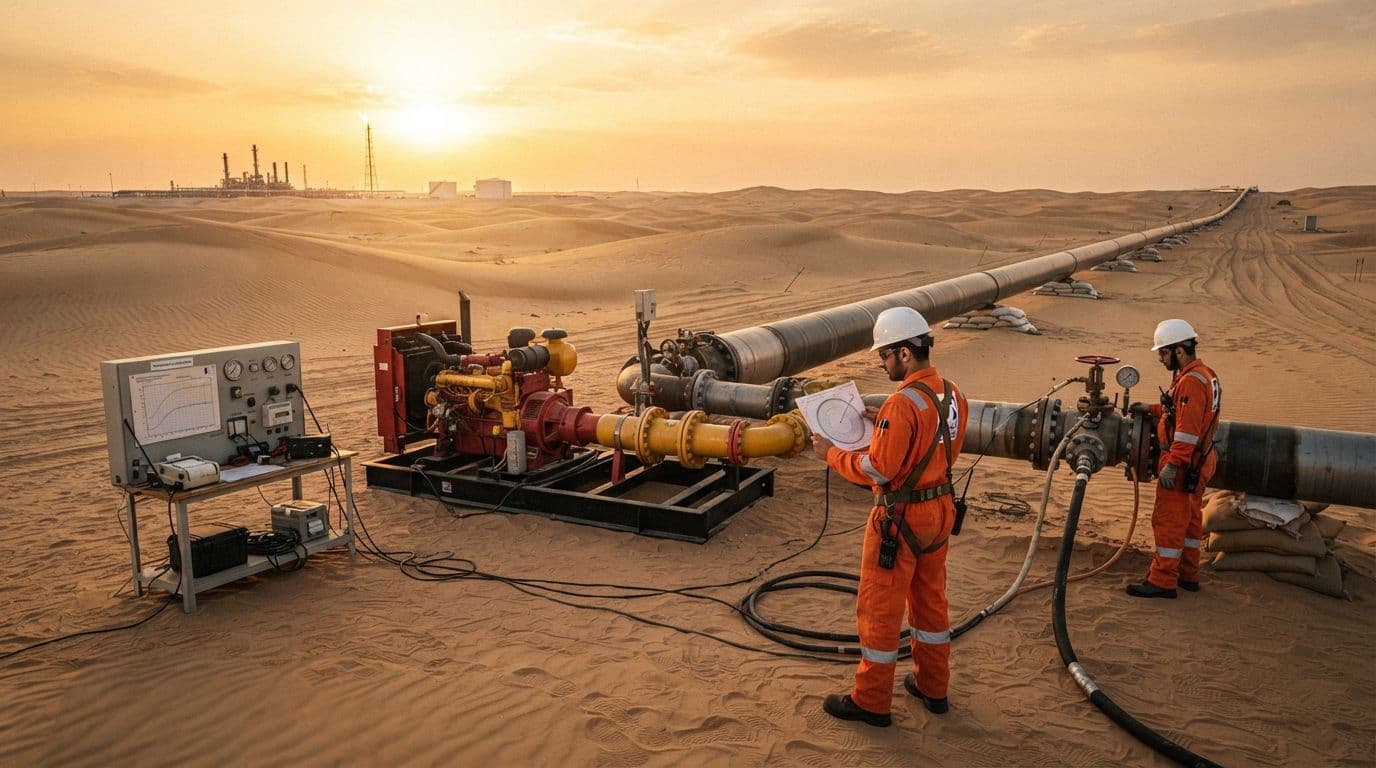
Introduction
If you're new to Abu Dhabi's oil, gas, water, or petrochemical industry, one of the first technical terms you'll encounter is "hydrotesting" — or its broader cousin, "pressure testing." Every pipeline in the UAE, whether it carries crude oil across the desert or potable water into a Khalifa City neighbourhood, has to be pressure tested before it goes into service.
Pipeline hydrotesting and pressure testing are how operators prove that a pipeline is strong enough, tight enough, and safe enough to carry its intended product for years or decades. They're the last major integrity check before commissioning, and they're the reason serious pipeline failures during operation are exceptionally rare.
This beginner's guide walks you through what pipeline hydrotesting and pressure testing are, how the process works, where they're used, and why they matter to Abu Dhabi's infrastructure industry.
What Is Pipeline Hydrotesting?
Pipeline hydrotesting is the practice of filling a completed pipeline with water and pressurising it to a level well above its normal operating pressure — typically 1.25 to 1.5 times the design pressure — to verify that it can safely handle service loads.
Water is used because it's essentially incompressible. If a weak spot in the pipeline fails during the test, water leaks out at a relatively slow rate. If pressurised gas were used instead, the same failure would release enormous stored energy in a fraction of a second — a far more dangerous outcome. That's why hydrotesting is the default method for almost every new pipeline in the UAE.
During the test, the pipeline is held at test pressure for a set period (usually four to twenty-four hours), and engineers monitor the pressure closely for any drop that would indicate a leak.
What Is Pressure Testing?
"Pressure testing" is the broader term that covers hydrotesting and a few less common methods. It refers to any test that pressurises a pipeline above operating levels to verify integrity. The main variations are:
- Hydrostatic testing (hydrotest) — the most common method, using water
- Pneumatic testing — using air or nitrogen, only permitted in specific low-risk cases due to the high stored energy involved
- Combined tests — where water is used first, followed by a low-pressure gas test to check for very small leaks
For virtually all pipeline commissioning in Abu Dhabi, hydrotesting is the standard. Pneumatic testing is reserved for small-diameter, short pipelines where water use isn't practical.
Why It Matters
Pipeline hydrotesting and pressure testing serve several critical purposes:
- Strength verification — proves the pipeline can hold pressure above normal operating levels
- Leak detection — surfaces any welds, fittings, or defects that would leak in service
- Regulatory compliance — required by codes such as ASME B31.4 (liquid pipelines), ASME B31.8 (gas pipelines), and operator-specific standards from ADNOC
- Insurance and financing — most operators and insurers require a documented hydrotest before accepting a pipeline as commissioned
- Baseline integrity record — the hydrotest report becomes part of the pipeline's permanent integrity file
Simply put: no hydrotest, no pipeline. Every new asset — from a small tie-in to a hundred-kilometre trunk line — goes through this step before it can carry product.
How the Process Works: Step by Step
A typical pipeline hydrotest follows a clear sequence:
1. Cleaning and gauging — The pipeline is cleaned with pigs to remove construction debris, and gauged to confirm it's free of obstructions.
2. Water filling — The pipeline is filled with test water, usually treated to control chloride, oxygen, and bacterial content — especially important for stainless steel pipelines where chloride can trigger stress corrosion cracking.
3. Deaeration — Trapped air is vented out through high-point vents. Air compresses under pressure, which makes accurate leak detection impossible, so full deaeration is essential.
4. Pressurisation — Water is pumped into the pipeline in controlled stages, with pauses to inspect the line at each stage.
5. Hold period — Once the target test pressure is reached, the pipeline is isolated and held for the required duration. Pressure and temperature are recorded continuously.
6. Temperature compensation — Water expands and contracts with temperature, which affects pressure readings. Engineers compensate mathematically to distinguish real leaks from thermal effects.
7. Depressurisation — After the hold period, the pipeline is depressurised in a controlled, staged manner.
8. Dewatering and drying — The pipeline is emptied and, for gas or dry service, dried to a specified dew point before commissioning.
9. Test report and certification — A complete report, including pressure/temperature charts, water quality records, and inspection notes, is issued and archived.
Common Applications in Abu Dhabi
Across Abu Dhabi's pipeline network, hydrotesting and pressure testing show up in a variety of situations:
- New pipeline commissioning — the mandatory test before any new pipeline enters service
- Post-construction acceptance — proving a contractor's completed work meets the specification
- Post-repair verification — after major repairs or tie-ins, sections are often re-tested to confirm integrity
- Change of service — repurposing a pipeline for a different product often triggers a fresh hydrotest
- Utility pipelines — water transmission mains, district cooling networks, and firewater systems all require pressure tests before handover
Safety Considerations
Pressure testing looks simple on paper but carries real risks. A pipeline under hydrotest can hold enough pressure to be lethal if a fitting fails or a person is in the wrong place at the wrong time. Standard safeguards include:
- Exclusion zones around the pipeline during pressurisation and hold
- Certified pressure relief devices on the test manifold
- Continuous monitoring of pressure and temperature by qualified personnel
- Environmental controls for test water disposal, especially where chemical inhibitors are used
- Full HSE plans aligned with UAE regulations and ADNOC standards for pressure testing
This is why hydrotesting is almost always carried out by specialist contractors with the right pumps, instrumentation, HSE systems, and engineering support — not by general construction crews.
Choosing the Right Contractor
For any operator or project planning a hydrotest in Abu Dhabi, the choice of contractor makes a real difference. The right partner brings calibrated pumps and pressure recorders, qualified test engineers, environmental permits for water sourcing and disposal, and a track record of accepted test reports.
When evaluating a pipeline contractor in Abu Dhabi for hydrotesting and pressure testing services, look for experience on similar pipelines, familiarity with ADNOC and other operator specifications, in-country equipment availability, and the ability to handle the full workflow — from initial fill through dewatering, drying, and final documentation. A contractor that owns the whole scope reduces coordination risk and keeps the project on schedule.
Conclusion
Pipeline hydrotesting and pressure testing might sound like just another compliance step, but they're much more than that. They're the final proof that a pipeline is safe, sound, and ready for years of reliable service. Every kilometre of pipeline running under Abu Dhabi's streets, deserts, and offshore assets has passed through this step at some point in its life.
For beginners in the industry, understanding pressure testing is a great foundation for everything else in pipeline operations. And for any operator planning a new pipeline, a repair, or a change of service, working with an experienced contractor is the safest and most cost-effective way to get the test done right the first time.