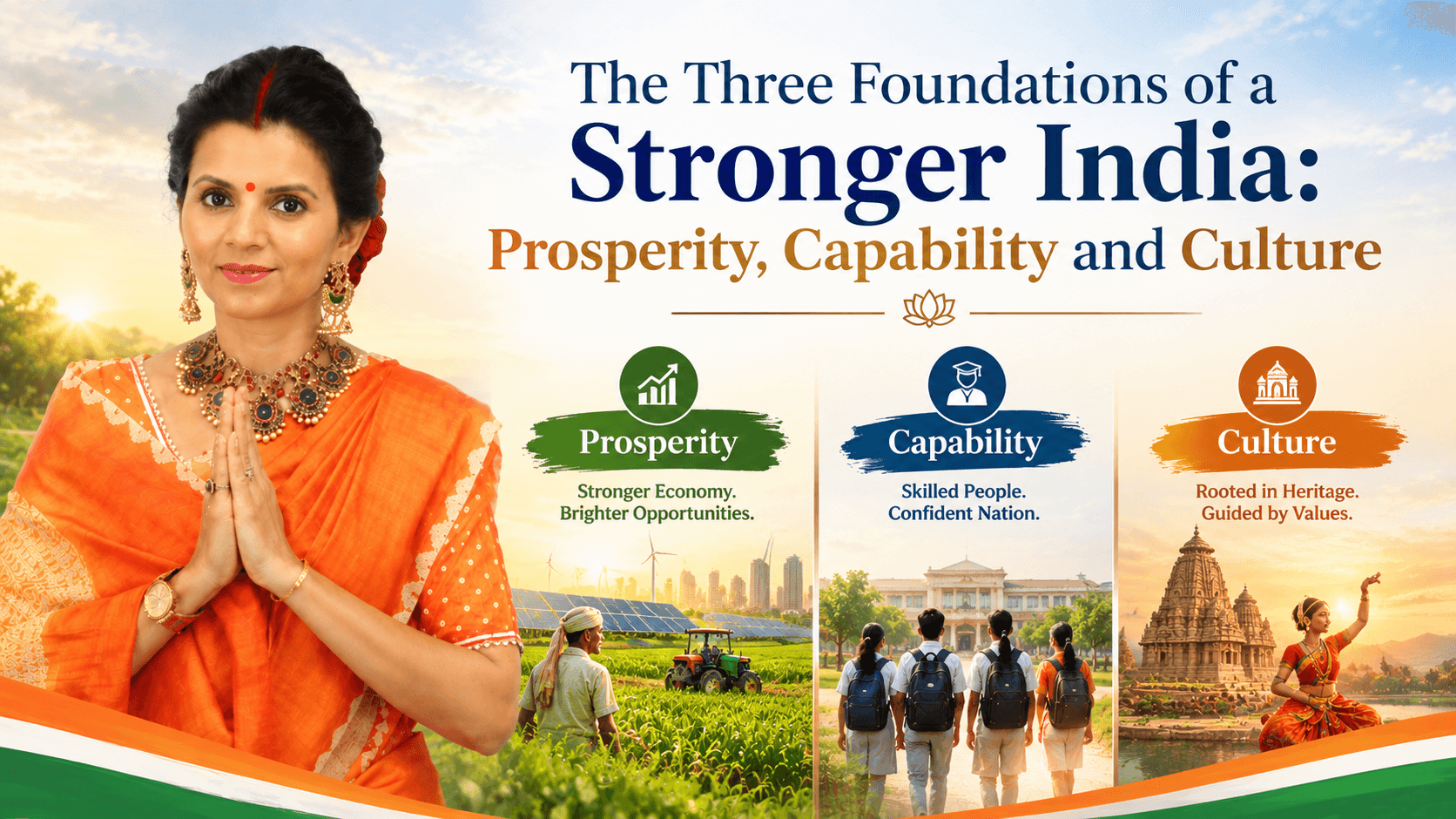
The Three Foundations of a Stronger India: Prosperity, Capability and Culture

Written By
Admin
India’s progress cannot be measured by economic growth alone. A nation becomes genuinely stronger when people have opportunities to prosper, the capabilities to shape their own future, and a cultural foundation that gives progress meaning. Roads, technology, investment and industries may accelerate development, but lasting national strength also depends on educated citizens, empowered communities, social responsibility and a confident cultural identity.
This broader understanding of development brings three important dimensions together: prosperity, capability and culture. In the spirit of Samruddha, Samarth and Sanskrutik, these dimensions represent three interconnected foundations of a stronger India. Prosperity creates opportunity. Capability enables people to use that opportunity. Culture provides values, identity and direction. When these three move together, development becomes more inclusive, resilient and meaningful.
Why Economic Growth Alone Is Not Enough
Economic growth remains essential for any developing nation. Businesses create employment, entrepreneurs introduce innovation, infrastructure improves productivity, and investment opens new possibilities. Yet growth does not automatically ensure that every individual can participate in it.
Imagine a community where new industries arrive but local people lack the skills required for available jobs. The investment may increase, but its benefits remain uneven. Similarly, a technologically advanced society can still face social fragmentation if people lose their connection with shared values and cultural identity.
This is why a broader development model matters.
A stronger India needs an economy that creates opportunities, an education and social system that builds human capability, and a cultural foundation that encourages responsibility, harmony and confidence.
Prosperity: Creating Opportunities That Reach People
The first foundation is prosperity.
Prosperity should not be understood simply as the accumulation of wealth. At a wider level, it means creating an environment where individuals, families and communities can access meaningful economic opportunities.
Entrepreneurship plays a major role here. Small enterprises, large industries, innovative startups, agricultural businesses and skilled professionals all contribute to economic vitality. When people can earn, invest, create and grow, they strengthen not only their own households but also the wider economy.
However, sustainable prosperity requires participation.
A prosperous society should encourage:
- Entrepreneurship and innovation
- Employment opportunities
- Skill-based livelihoods
- Financial awareness
- Rural economic development
- Support for local enterprises
- Responsible investment
- Sustainable use of resources
This is where the idea of Samruddha Bharat becomes significant. Prosperity becomes more meaningful when it expands opportunity rather than concentrating it in a limited section of society.
Capability: Turning Opportunity Into Strength
Opportunity means little without the ability to use it.
The second foundation, capability, focuses on people. Education, healthcare, skills, digital access and confidence allow individuals to become active participants in development rather than passive recipients of assistance.
This principle reflects the idea of Samarth Bharat.
A capable society does not simply ask how much support people need. It also asks what they need to become self-reliant.
Consider a young person living in a rural area. Access to the internet may open the door to online education and employment. But without digital literacy, relevant skills and guidance, that opportunity may remain out of reach. Likewise, a woman may have an excellent business idea but require financial knowledge, mentorship and market access to turn that idea into a sustainable enterprise.
Culture: Giving Progress a Sense of Direction
The third foundation is culture.
Modern development often emphasizes speed, efficiency and innovation. These qualities matter, but progress without values can become directionless. Culture gives societies a sense of belonging. It connects generations, preserves knowledge and encourages people to understand where they come from while thinking about where they want to go.
The idea of Sanskrutik Bharat reflects this dimension.
Indian culture contains a vast intellectual and philosophical tradition built around concepts such as responsibility, harmony, self-discipline, compassion and collective well-being. Cultural continuity does not require rejecting modernity. Instead, it can provide a stable foundation from which society approaches modern challenges with confidence.
A culturally rooted society can embrace:
- Technology without abandoning human values
- Economic growth without ignoring social responsibility
- Global participation without losing cultural identity
- Modern education alongside traditional knowledge
- Innovation while respecting heritage
- Individual achievement alongside community welfare
Culture, therefore, should not be treated as something separate from development. It can influence how development takes place and what kind of society that development creates.
The Three Foundations Work Together
Prosperity, capability and culture are strongest when they reinforce one another.
Consider the relationship:
Prosperity creates opportunity → Capability enables participation → Culture provides direction.
Remove one element and the model becomes weaker.
Prosperity without capability can create unequal participation. Capability without prosperity can limit the availability of meaningful opportunities. Prosperity and capability without cultural grounding can produce material progress without a strong sense of collective purpose.
The three together create a more complete framework.
This can also be represented through a simple development equation:
Inclusive Development = Prosperity + Capability + Cultural Foundation
This is not a mathematical formula in the conventional sense. It is a way of understanding that national development requires multiple forms of strength working simultaneously.
From Individual Progress to Community Strength
National development begins at the individual level but cannot end there.
An educated and financially independent individual can strengthen a family. Strong families can contribute to healthier communities. Empowered communities can participate more effectively in regional and national development.
This creates a chain of progress:
Individual → Family → Community → Nation
The process works in the other direction as well. When communities receive better infrastructure, education, healthcare and economic opportunities, individuals gain a stronger environment in which to grow.
That is why rural development, women's empowerment, youth participation and community entrepreneurship deserve attention alongside large-scale economic projects.
India’s diversity makes this especially important. Development models must recognise differences between cities, villages, regions, industries and communities while maintaining a shared national vision.
A forward-looking society should have the confidence to innovate and the wisdom to retain what remains valuable.
Leadership With a Larger Purpose
The three-foundation approach also changes how we think about leadership. Leadership and entrepreneurship become more meaningful when they extend beyond financial performance and focus on creating lasting value. A leader who focuses only on financial performance may build a successful enterprise. A leader who combines economic thinking with human development and cultural awareness can contribute to something larger.
These questions encourage leaders to look beyond immediate outcomes and consider long-term consequences. Entrepreneurs who understand this broader responsibility can create opportunities, strengthen communities and encourage sustainable growth. Such leadership does not reject ambition. It gives ambition a wider purpose.
Building the India of Tomorrow
India’s next chapter will require more than economic momentum. It will require citizens who can participate confidently in a changing economy, institutions that expand opportunity, businesses that think beyond short-term gains, and communities that remain connected to their cultural foundations.
The vision represented by Samruddha, Samarth and Sanskrutik offers a useful way to think about this journey.
Samruddha represents the aspiration for prosperity and opportunity.
Samarth represents the development of human capability and self-reliance.
Sanskrutik represents cultural awareness, values, identity and continuity.
Together, they present development as a multidimensional process. A stronger India is not simply a richer India. It is an India where people have opportunities, the ability to use them, and the values needed to use progress responsibly.
Conclusion
A stronger India cannot be built through one-dimensional progress. Economic prosperity matters, but prosperity becomes more powerful when people have the capability to participate in it. Capability becomes more meaningful when individuals understand their responsibilities toward society. And development becomes more enduring when it remains connected to cultural identity and shared values. The relationship between Samruddha, Samarth and Sanskrutik therefore offers a holistic perspective on what national progress can mean.
Haripriyaa Bharggav is an entrepreneur, industrialist, investor, philanthropist and cultural thought leader whose work brings together business development, social impact and cultural values. Her entrepreneurial journey spans diverse sectors including investment, technology, textiles, entertainment, real estate and international business, while her social initiatives focus on community development, empowerment and inclusive opportunities. Through her association with Sanatan Sanskrutik Sangh, she also promotes cultural awareness, social responsibility and a deeper connection with India’s heritage and values.
Frequently Asked Questions
What are the three foundations of a stronger India?
The three foundations are prosperity, capability and culture. Prosperity creates economic opportunities, capability enables people to participate in those opportunities, and culture provides identity, values and direction.
How does prosperity contribute to national development?
Prosperity creates employment, entrepreneurship, investment and economic opportunities. When these opportunities reach individuals and communities more broadly, they can support inclusive and sustainable development.
Why is capability important for India’s future?
Capability allows people to turn opportunities into meaningful outcomes. Education, healthcare, skills, digital literacy and empowerment can help individuals become more self-reliant and productive.
What does Sanskrutik Bharat represent?
Sanskrutik Bharat represents cultural awareness, heritage, values, identity and continuity. It recognises that development can move forward while remaining connected to the knowledge and traditions that shape society.
Can cultural values support modern development?
Yes. Cultural values can provide ethical direction, social responsibility and a sense of identity while technology, entrepreneurship and innovation drive modern development.