
White Label Document Management System: Features, Benefits, and Business Use Cases

Written By
Admin
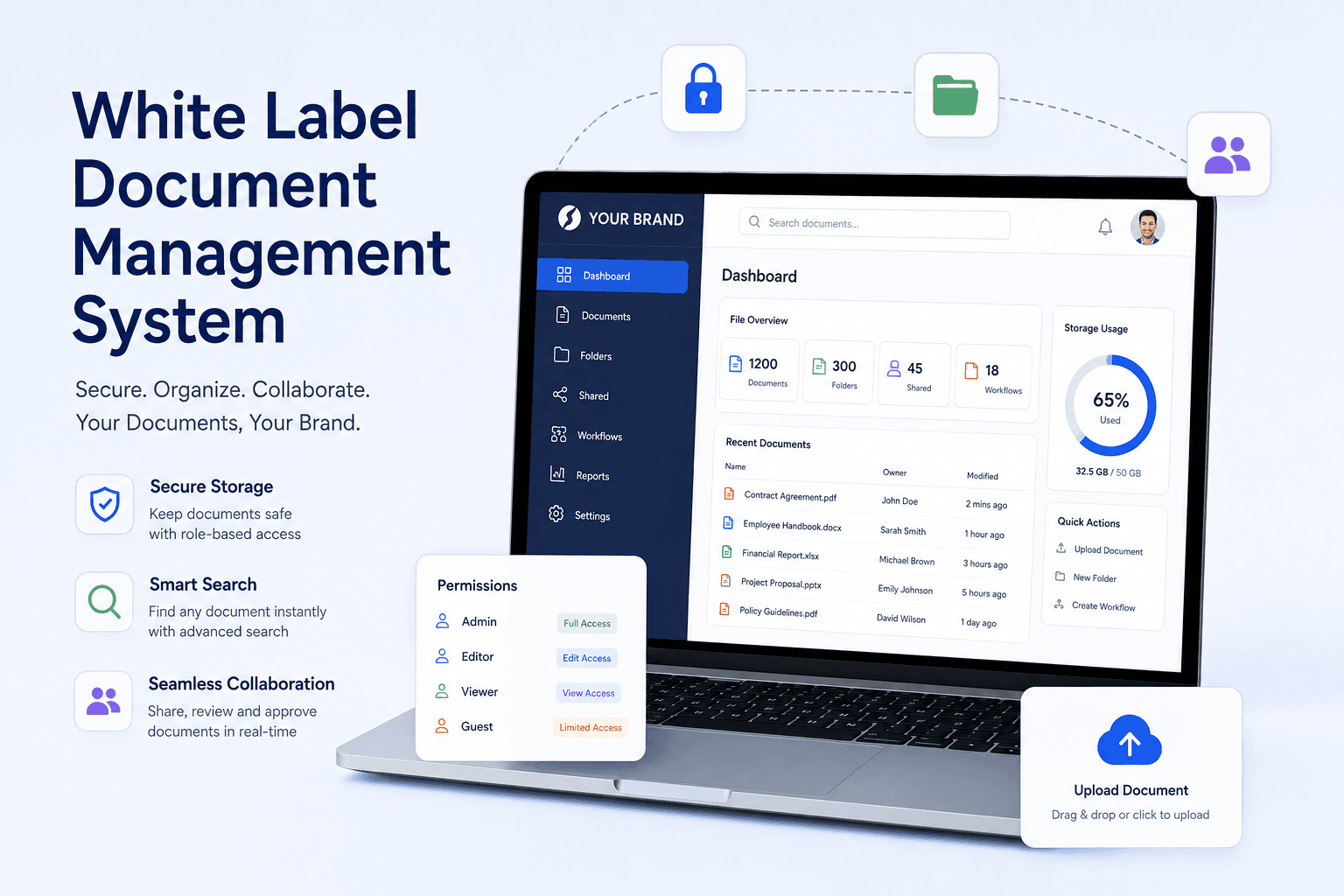
Businesses today handle thousands of documents every day, including contracts, invoices, employee records, compliance reports, customer files, and internal communications. Managing these documents manually often leads to inefficiencies, security risks, compliance challenges, and increased operational costs. As organizations continue their digital transformation journey, document management solutions have become a critical business requirement.
A white label document management system provides organizations, software vendors, startups, and enterprises with a ready-made platform that can be customized and rebranded as their own solution. Instead of investing significant resources into building a document management platform from scratch, businesses can leverage an existing infrastructure and launch their branded solution quickly.
The growing demand for automation, cloud-based collaboration, and AI-powered workflows has further increased the popularity of white label document management software. Many organizations are now integrating advanced capabilities from white label ai software solutions to automate document processing, improve search functionality, and enhance operational efficiency.
This article explores the features, benefits, and business use cases of white label document management systems and explains why they are becoming essential for modern enterprises.
Understanding What a White Label Document Management System Is
A white label document management system is a pre-built software platform that enables businesses to store, organize, manage, share, and secure digital documents under their own brand identity.
The software provider develops and maintains the core technology while allowing clients to customize the platform with their company logo, colors, domain name, user interface elements, and specific business workflows.
This approach allows organizations to offer document management services without investing years into software development, testing, maintenance, and infrastructure management.
A white label document management system typically includes document storage, indexing, search capabilities, access controls, workflow automation, compliance tools, and collaboration features.
Businesses can deploy the solution for internal operations or offer it as a commercial SaaS product to customers.
Why Businesses Are Adopting White Label Document Management Software
The demand for digital document management has increased significantly due to remote work environments, compliance regulations, cloud adoption, and data security requirements.
Organizations face several challenges when handling documents manually:
- Lost or misplaced files
- Version control issues
- Security vulnerabilities
- Limited accessibility
- Slow approval processes
- Compliance risks
- Storage inefficiencies
White label document management software addresses these challenges by centralizing document storage and enabling secure access from anywhere.
For software providers and technology startups, the white label approach significantly reduces development costs while accelerating time-to-market.
Core Features of a White Label Document Management System
Secure Centralized Document Repository
A centralized repository serves as the foundation of any document management platform. It allows businesses to store all documents in a single location while maintaining organized folder structures and metadata tagging.
Users can quickly access information without searching through multiple storage systems, emails, or physical archives.
Key capabilities include:
- Cloud storage
- Document categorization
- Folder hierarchy management
- Metadata tagging
- Document indexing
- Bulk uploads
Advanced Search and Retrieval Functionality
As document volumes grow, finding information quickly becomes increasingly important.
Modern white label document management software includes advanced search capabilities that allow users to locate files based on:
- Keywords
- Metadata
- File type
- Date ranges
- User activity
- Document categories
Many platforms also incorporate AI-powered search functionality for faster and more accurate retrieval.
Document Version Control and History Tracking
Version management ensures that teams always work with the latest document version while maintaining access to historical revisions.
Version control features typically include:
- Automatic version creation
- Revision tracking
- Audit logs
- Rollback functionality
- User change history
This prevents accidental overwrites and improves accountability across teams.
Role-Based Access Control and Permissions Management
Data security is a top priority for organizations handling confidential information.
A white label document management system allows administrators to define user roles and access permissions based on job responsibilities.
Access control capabilities include:
- User authentication
- Role-based permissions
- Department-level access
- Read-only access settings
- Multi-factor authentication
- User activity monitoring
These controls help protect sensitive business information from unauthorized access.
Workflow Automation and Approval Management
Automated workflows streamline document-related processes and reduce manual intervention.
Organizations can automate:
- Document approvals
- Contract reviews
- Employee onboarding documents
- Compliance reporting
- Invoice processing
- Policy acknowledgments
Workflow automation accelerates operations while reducing human errors.
Collaboration and Real-Time Document Sharing
Modern businesses require seamless collaboration across departments and locations.
Document management platforms support:
- Real-time editing
- File sharing
- Internal comments
- Team collaboration
- Notifications
- Task assignments
These capabilities improve communication and productivity throughout the organization.
How White Label AI Software Enhances Document Management Systems
Artificial intelligence has transformed the way businesses manage information.
Many organizations now integrate white label ai software into their document management platforms to automate repetitive tasks and improve efficiency.
AI-Powered Document Classification
Artificial intelligence can automatically identify document types and categorize files without manual tagging.
Examples include:
- Contracts
- Invoices
- Purchase orders
- Employee records
- Compliance reports
- Customer applications
Automated classification reduces administrative workloads while improving organization.
Intelligent Data Extraction
AI-powered systems can extract critical information from documents and populate databases automatically.
Extracted information may include:
- Customer names
- Invoice amounts
- Contract dates
- Vendor details
- Identification numbers
This eliminates manual data entry and reduces processing errors.
Optical Character Recognition (OCR)
OCR technology converts scanned documents and images into searchable digital content.
Benefits include:
- Faster search functionality
- Improved document accessibility
- Reduced storage dependency
- Enhanced data retrieval
OCR significantly increases the value of archived documents.
AI-Driven Search and Knowledge Discovery
Traditional search methods rely on exact keyword matches.
AI-powered search systems understand context and intent, helping users locate relevant documents even when specific keywords are unavailable.
This capability improves productivity and decision-making.
Predictive Workflow Recommendations
Advanced AI engines analyze user behavior and workflow patterns to recommend process improvements.
Examples include:
- Suggested approvers
- Automated routing
- Task prioritization
- Document categorization recommendations
These capabilities improve operational efficiency over time.
Major Benefits of Implementing a White Label Document Management System
Faster Time-to-Market
Developing document management software from scratch can take months or years.
A white label solution enables businesses to launch significantly faster using proven infrastructure and existing technology.
This reduces both risk and development timelines.
Lower Development Costs
Custom software development requires substantial investments in:
- Development teams
- Infrastructure
- Testing
- Security implementation
- Ongoing maintenance
White label document management software eliminates many of these expenses by providing a ready-made solution.
Enhanced Brand Identity
Organizations can fully customize the platform to align with their brand.
Customization options typically include:
- Logos
- Colors
- Domains
- User interfaces
- Dashboard layouts
- Reporting templates
This creates a consistent brand experience for customers and employees.
Improved Security and Compliance
Document management platforms are designed to meet strict security and compliance standards.
Common compliance support includes:
- GDPR
- HIPAA
- ISO standards
- SOC certifications
- Financial regulations
These capabilities help organizations reduce legal and operational risks.
Better Operational Efficiency
Centralized document management reduces the time employees spend searching for information and managing files manually.
Automation and collaboration features further improve productivity across departments.
Scalability for Future Growth
As businesses grow, document volumes increase rapidly.
A scalable white label document management system can accommodate growing data requirements without requiring major infrastructure upgrades.
Industry-Specific Business Use Cases for White Label Document Management Software
Healthcare Organizations
Healthcare providers manage vast amounts of sensitive patient information and regulatory documentation.
Use cases include:
- Electronic medical records
- Insurance documentation
- Patient consent forms
- Compliance reporting
- Clinical documentation management
Financial Services and Banking
Financial institutions require secure document storage and strict compliance controls.
Common applications include:
- Loan processing
- Customer onboarding
- Audit management
- Financial reporting
- Investment documentation
Legal Firms and Professional Services
Law firms handle extensive documentation that requires accurate version control and secure storage.
Typical use cases include:
- Contract management
- Case documentation
- Client records
- Legal correspondence
- Compliance tracking
Human Resource Management
HR departments manage employee-related documents throughout the employee lifecycle.
Examples include:
- Recruitment files
- Employment contracts
- Performance reviews
- Payroll documentation
- Compliance records
Real Estate Companies
Real estate organizations rely heavily on document-intensive processes.
Common use cases include:
- Property agreements
- Lease documentation
- Mortgage records
- Property inspections
- Regulatory compliance files
Education Institutions
Educational organizations use document management systems to manage student and administrative records.
Applications include:
- Student records
- Academic certificates
- Faculty documentation
- Admission applications
- Accreditation reports
Key Factors to Consider Before Choosing a White Label Document Management System
Customization Flexibility
Businesses should evaluate how extensively they can customize the platform to meet branding and operational requirements.
Security Architecture
The platform should include robust security measures such as encryption, access controls, audit trails, and authentication mechanisms.
AI Integration Capabilities
Organizations planning to leverage automation should assess available white label ai software integration options.
Scalability
The solution should support increasing document volumes, users, and storage requirements.
Third-Party Integrations
Compatibility with existing systems such as CRM, ERP, HRMS, and cloud storage platforms is essential.
Support and Maintenance Services
Reliable technical support and ongoing maintenance ensure uninterrupted business operations.
Future Trends Shaping White Label Document Management Software
The document management industry continues to evolve with emerging technologies.
Key trends include:
- AI-driven content management
- Intelligent automation
- Natural language document search
- Predictive analytics
- Blockchain-based document verification
- Enhanced cybersecurity frameworks
- Cloud-native architecture
- Hybrid document ecosystems
As businesses increasingly prioritize digital transformation, demand for advanced white label document management software solutions will continue to grow.
Conclusion
A white label document management system provides organizations with a cost-effective and scalable way to manage digital documents while maintaining complete brand ownership. These platforms help businesses improve security, streamline workflows, enhance collaboration, and ensure regulatory compliance.
The integration of white label ai software further strengthens document management capabilities through intelligent search, automated classification, OCR, and workflow automation. Whether serving healthcare, finance, legal, education, or enterprise sectors, white label document management software offers a practical solution for organizations seeking digital efficiency and long-term scalability.
What is a white label document management system?
A white label document management system is a pre-built document management platform that businesses can customize and rebrand as their own solution. It enables organizations to offer document storage, sharing, workflow automation, and document security under their brand identity.
How does white label document management software benefit businesses?
White label document management software reduces development costs, accelerates product launch timelines, improves document security, enhances collaboration, and provides scalable document management capabilities.
Can AI be integrated into a document management system?
Yes. Many organizations integrate white label ai software into document management platforms to automate document classification, data extraction, OCR processing, intelligent search, and workflow optimization.
Which industries benefit most from document management systems?
Industries such as healthcare, finance, legal services, education, human resources, government organizations, and real estate benefit significantly from document management solutions.
Is a white label document management system secure?
Most modern platforms include enterprise-grade security features such as encryption, role-based access control, multi-factor authentication, audit trails, and compliance support for industry regulations.
How long does it take to launch a white label document management software solution?
Implementation timelines vary depending on customization requirements, integrations, and deployment preferences. However, white label solutions are typically launched much faster than custom-built platforms.
What should businesses look for when selecting a white label document management system?
Businesses should evaluate customization options, security features, AI capabilities, scalability, integration support, compliance standards, and ongoing maintenance services before choosing a platform.